

Iran’s latest jet‑powered loitering munition sharpens strategic threat as air defence costs rise
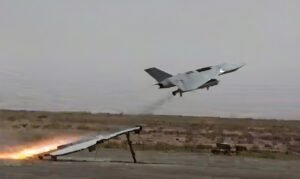
WEB DESK: Iran’s Islamic Revolutionary Guard Corps (IRGC) has quietly begun deploying the Hadid‑110, a jet‑powered loitering munition that represents a significant leap from the slow, propeller‑driven drones that have dominated recent conflict zones.
According to U.S. Central Command, Tehran has been equipping operational units with advanced drones since late 2025, building on its Shahed lineage. But the Hadid‑110’s jet propulsion and “stealth‑lite” design signal a new tier of capability, complicating counter‑air operations across the Middle East.
Constructed from composite plastics and carbon fibers, the Hadid‑110 scatters radar energy and is far harder for long‑range sensors to detect. Analysts say the jet drone’s 30–50 kg warhead is comparable to the Shahed‑136’s payload but delivered at nearly three times the speed, with an estimated 350 km range. Designed to penetrate gaps in air defences, it is expected to target radars, command posts, and other high‑value assets.
The deployment has reignited debate in the Pentagon over defence economics, where shooting multi‑million‑dollar missiles to stop inexpensive drones is increasingly untenable. As low‑altitude, high‑speed threats proliferate, Western militaries are accelerating investment in cost‑effective countermeasures such as directed‑energy weapons and advanced electronic warfare systems.
About The Author