

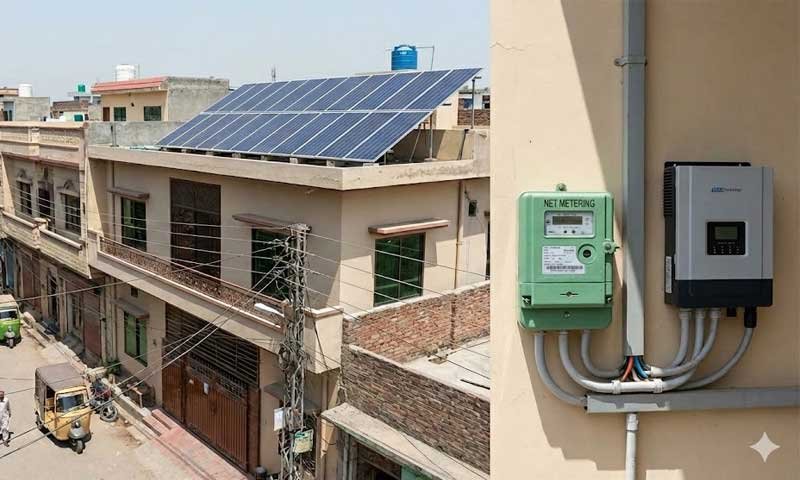
The federal government is preparing to overhaul Pakistan’s rooftop solar electricity framework by replacing the existing net metering system with a net billing policy, a move expected to significantly increase costs for solar consumers.
Under the current net metering system, households and businesses offset electricity imported from the grid against power exported from their solar panels on a unit-for-unit basis, often resulting in minimal or zero bills. The proposed net billing regime, however, will charge consumers full retail tariffs for electricity drawn from the grid while crediting exported solar power at a lower rate.
Energy analysts estimate that a consumer importing and exporting 300 units of electricity could face a monthly bill of around Rs10,000, compared to negligible charges under net metering. The government and power distribution companies argue the change is necessary to recover grid maintenance costs and address revenue shortfalls. Critics counter that it penalises consumers who invested in solar to ease pressure on the national power system.
The transition follows operational challenges, including thousands of pending net-metering applications and delays in solar meter installations, with some distribution companies halting new connections.
Last month, NEPRA proposed a gross metering model, offering a fixed feed-in tariff of Rs11.30 per unit for exported electricity, while billing all imports at retail rates. Existing net-metering customers will retain higher rates until their contracts expire. NEPRA has invited public feedback before finalising the policy.