
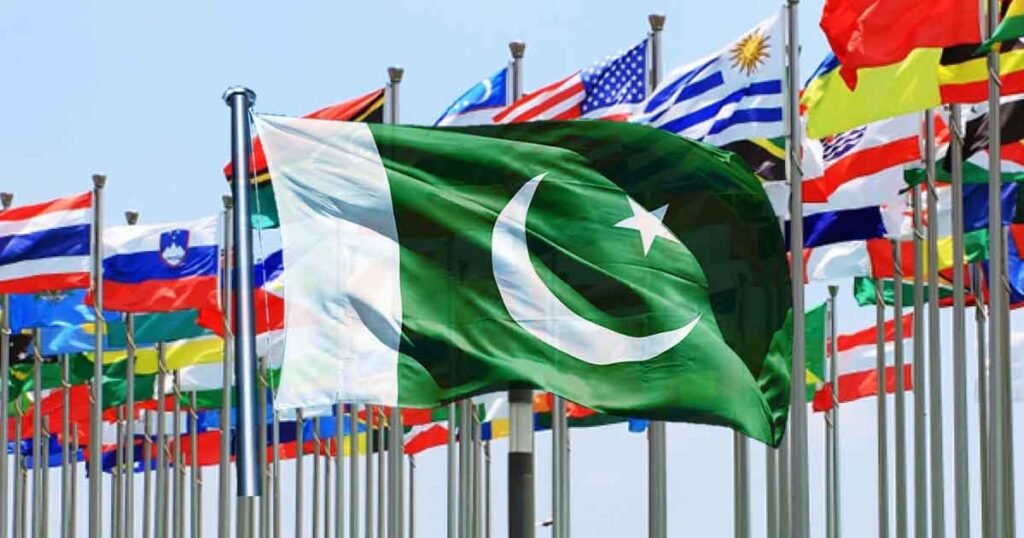

Pakistan’s relationship with the world has been shaped by its geo-strategic location, ideological foundation, security needs, and domestic political developments. Since its creation in 1947, Pakistan has stood at the crossroads of South Asia, Central Asia, the Middle East, and the Indian Ocean region, giving it immense geopolitical significance. Early in its history, Pakistan aligned itself closely with Western powers, joining security alliances such as SEATO and CENTO in the 1950s, primarily to address its security concerns vis-à-vis India and to seek military and economic support.
Through these alliances, Pakistan developed a reputation as a frontline state against communism during the Cold War. However, its relationship with the West, particularly the United States, has been cyclical, characterized by periods of cooperation followed by phases of mistrust. Pakistan’s ties with China, on the other hand, evolved into a deep, time-tested strategic partnership often described as “all-weather.” China has supported Pakistan in critical areas, including defense cooperation, infrastructure development, nuclear energy, and economic investments, with the China-Pakistan Economic Corridor (CPEC) marking a transformative phase in their relationship.
Pakistan also maintains strong historical ties with the Muslim world, particularly Saudi Arabia, the United Arab Emirates, Turkey, Iran, and other Middle Eastern countries, with cooperation spanning labor, trade, defense, and diplomacy. In the broader international sphere, Pakistan has consistently advocated for peace, multilateralism, and the self-determination of oppressed nations, particularly highlighting the Kashmir issue at global forums such as the United Nations.
In its stance on counter-terrorism, Pakistan has undergone a significant evolution. Once facing immense criticism for being affected by the spillover of regional conflicts, particularly the Soviet-Afghan War, Pakistan emerged as one of the major victims of terrorism in the post-9/11 era. The rise of extremist groups and insurgent networks posed grave challenges to its internal security, economy, and global reputation. In response, Pakistan launched several comprehensive military operations to eradicate militancy, including Zarb-e-Azb, Rah-e-Nijat, Rah-e-Raast, and later Radd-ul-Fasaad.
These operations targeted militant strongholds in the tribal areas and helped dismantle major terrorist networks. Pakistan’s security forces, including the Army, Frontier Corps, Intelligence agencies, and police, worked cohesively to establish the writ of the State across previously lawless regions. Pakistan’s sacrifices in the war on terror have been globally recognized, as the country lost tens of thousands of civilians and security personnel.
In addition to military action, Pakistan focused on strengthening its legal and financial frameworks to combat extremism, regulate religious institutions, and curb terror financing. Its narrative gradually shifted towards promoting moderate Islam, interfaith harmony, and a zero-tolerance approach to any form of terrorism. Pakistan’s interaction with the Financial Action Task Force (FATF) further shaped its global counter-terrorism profile.
Peacekeeping has been one of Pakistan’s proudest contributions to global stability. Since joining the United Nations in 1947, Pakistan has become one of the largest contributors to UN peacekeeping missions worldwide. Pakistani troops have served in some of the most volatile and conflict-ridden regions, including Congo, Somalia, Sierra Leone, Liberia, Côte d’Ivoire, Haiti, Sudan, Bosnia, and East Timor. Known for professionalism, discipline, and bravery, Pakistani peacekeepers have earned immense respect for protecting civilians, supporting humanitarian assistance, clearing landmines, and assisting post-conflict reconstruction.
The relationship between Pakistan and India has been central to South Asian geopolitics. Both nations, born from the partition of British India in 1947, have fought multiple wars, with the core dispute revolving around the region of Jammu and Kashmir. The first Indo-Pakistan war of 1947–48 broke out immediately after independence when tribesmen from Pakistan’s northwest moved into Kashmir following the Maharaja’s controversial accession to India.
The conflict ended with a UN-mandated ceasefire, dividing Kashmir into Pakistani-administered and Indian-administered regions. The second war in 1965 erupted after tensions escalated in the Rann of Kutch and across the Kashmir border, leading to a full-scale war marked by aerial dogfights and armored clashes. Both sides claimed victory, but the conflict ended with the Tashkent Agreement of 1966.
Pakistan’s armed forces have played a central role in defending the country’s territorial integrity since independence. Given Pakistan’s strategic vulnerabilities, long borders with India and Afghanistan, a coastline along the Arabian Sea, and rugged mountainous regions, the armed forces have operated in diverse terrains and under complex security environments.
The Pakistan Army, Navy, and Air Force have collectively ensured deterrence and preparedness against external aggression while also participating in internal security duties. The Army, being the largest branch, has been at the forefront of defending land borders, especially along the Line of Control with India and the western frontier with Afghanistan.
In conclusion, Pakistan’s relationships with the world, its counter-terrorism policies, peacekeeping contributions, military history with India, and the pivotal role of its armed forces collectively define its national identity and geopolitical significance. As Pakistan continues to navigate a complex international environment, it seeks to position itself as a responsible state committed to peace, stability, and cooperation. Balancing global partnerships while protecting national interests remains a core challenge. Yet, through resilience, strategic thinking, and diplomatic engagement, Pakistan aims to contribute positively to regional and global security while fostering an environment conducive to economic progress and long-term stability.
Note: The views expressed in this article are solely those of the writer and do not necessarily reflect the policies or views of Click Pakistan.
About The Author