
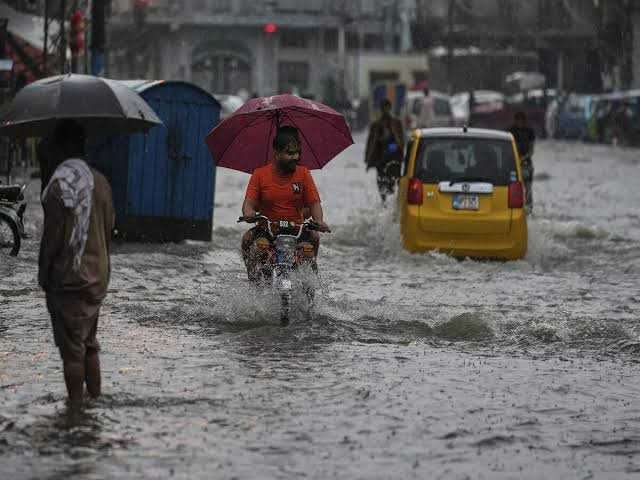

Heavy monsoon rainfall has prompted fresh flood alerts across Pakistan, with authorities monitoring rising river flows, urban flooding risks, and landslide threats as another spell of rain is forecast.
Pakistan remained on high alert on Tuesday after persistent monsoon rains battered several regions, prompting fresh flood warnings, raising river levels, and increasing concerns over urban flooding and landslides. Disaster management authorities have intensified monitoring as another spell of rainfall is expected over the next 24 to 48 hours.
According to the Pakistan Meteorological Department (PMD), weak monsoon currents continue to influence the country’s upper and eastern regions, while a westerly weather system is affecting northwestern areas. Humid conditions are expected to persist, with rain and thunderstorms forecast for Kashmir, Gilgit-Baltistan, Khyber Pakhtunkhwa, and upper Punjab through Wednesday.
The Flood Forecasting Division (FFD) reported that the Indus River remains at a low flood level at Kalabagh and Chashma, while all other major rivers are flowing within normal limits. Officials said the overall hydrological situation is expected to remain stable, although additional rainfall in upper catchment areas could slightly increase river flows.
Chenab River Closely Monitored
Authorities are paying close attention to the Chenab River after India released additional water from the Baglihar Dam following heavy rainfall in the upper catchment. Reports indicate three more spillway gates were opened on Monday, adding to earlier releases and increasing downstream flows.
The FFD has issued a low-to-medium flood alert for Head Marala during the next 24 hours. Current inflows are around 93,900 cusecs, while outflows stand at approximately 76,200 cusecs. Forecasts suggest inflows could range between 80,000 and 100,000 cusecs, with the river expected to remain within the low flood category.
Heavy Rainfall Across Several Regions
Widespread rainfall was recorded across Khyber Pakhtunkhwa, Punjab, Balochistan, Gilgit-Baltistan, and Azad Kashmir during the past 24 hours.
Among the highest rainfall totals reported by the PMD were Saidu Sharif with 86 millimetres, Faisalabad with 77 millimetres, and Kakul with 71 millimetres. Sibbi remained the country’s hottest city, recording a maximum temperature of 44 degrees Celsius.
The FFD’s rainfall monitoring network reported exceptionally heavy rainfall in Faisalabad, where Ghulam Muhammad Abad Water Works received 126 millimetres of rain and the WASA Head Office recorded 123 millimetres. Significant rainfall was also reported in Lahore, Sialkot, Gujrat, and nearby districts.
PDMA Warns of Urban Flooding
Punjab’s Provincial Disaster Management Authority (PDMA) said advance planning and the timely deployment of drainage equipment helped reduce water accumulation despite heavy downpours. However, the authority warned that the current monsoon spell is expected to continue until August 5.
Officials cautioned that urban flooding remains a major concern in Lahore, Rawalpindi, Gujranwala, Gujrat, Sialkot, Faisalabad, and Multan. Meanwhile, continuous rainfall has increased the risk of landslides in Murree, Galliyat, and other mountainous areas.
About The Author