
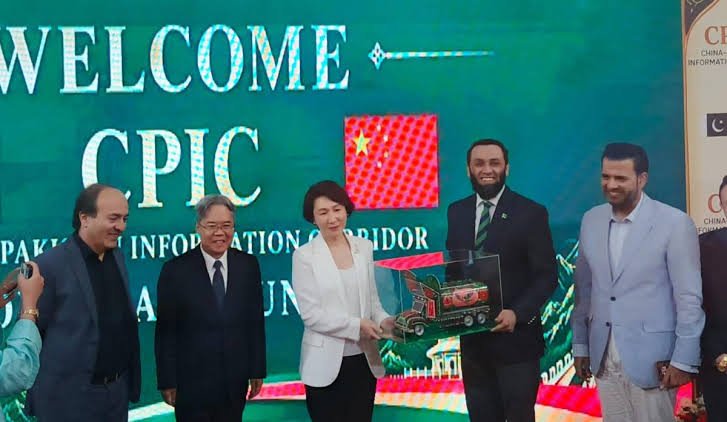

Information Minister Attaullah Tarar says the initiative will strengthen Pakistan-China ties through media collaboration, trade, think tanks, cultural exchanges and youth engagement.
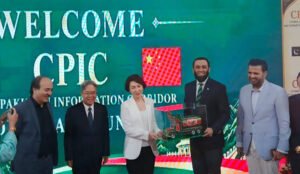
Pakistan and China are seeking to deepen bilateral relations through a new Information Corridor focused on media cooperation, trade, research, cultural exchanges and youth engagement, Federal Minister for Information and Broadcasting Attaullah Tarar said at the initiative’s opening ceremony.
Tarar described the China-Pakistan Information Corridor as a digital bridge designed to strengthen mutual understanding, promote verified information and carry the longstanding friendship between the two countries to younger generations.
“While CPEC connects our economies, the Information Corridor will connect our mutual understanding,” Tarar said, describing the initiative as the voice of the two countries’ shared future.
He said the corridor had become increasingly important in an era when digital communication, information exchange and control over narratives were shaping international relations. He added that the initiative would respond to falsehoods with facts, isolation with exchange and mistrust with confidence.
Four pillars of cooperation
Tarar said the China-Pakistan Information Corridor was built on four pillars: media, trade, think tanks, and culture, tourism and youth. According to the minister, work had begun under all four components.
The media pillar includes a News Exchange Working Group comprising 18 Pakistani and Chinese media organisations, including public broadcasters, private television channels, Xinhua, China Media Group and People’s Daily. Tarar said participating organisations share verified news and cooperate on fact-checking to identify misleading narratives and respond with evidence.
Under the trade pillar, the initiative has established its first regional office in Karachi. A trade portal is being developed to document trade, investment and foreign direct investment, while a podcast series highlights the experiences of Chinese businesspeople in Pakistan and Pakistani entrepreneurs in China.
The think tank component will support bilateral dialogue through joint discussions, research and publications, providing an evidence-based foundation for cooperation.
The fourth pillar focuses on culture, tourism and young people. Tarar said work was underway on a tourism corridor between Xinjiang and Gilgit-Baltistan to expand Chinese tourists’ access to Pakistan’s northern areas. A friendship rally is also planned for the year commemorating Pakistan-China friendship.
He added that young people from 13 universities across Pakistan had been nominated for the first group of youth ambassadors, with institutions from Gilgit to Quetta, Peshawar to Karachi, and Muzaffarabad to Lahore included.
CPEC and digital transformation
Tarar linked the initiative to the broader China-Pakistan Economic Corridor (CPEC), describing the flagship project of China’s Belt and Road Initiative as a means of translating decades of goodwill into infrastructure, energy and economic development.
He said the first phase of CPEC connected physical infrastructure, while the next phase would focus on connecting people and ideas. Under CPEC 2.0, Prime Minister Shehbaz Sharif and Chinese President Xi Jinping had outlined a new phase centred on growth, employment, innovation, environmentally friendly development and openness, according to Tarar.
The minister also highlighted the fibre-optic cable passing through the Khunjerab Pass, which directly connects Pakistan and China. He described the mountain pass as a geographical link between the two countries and a symbol of their enduring partnership.
Tarar said Pakistan’s digital transformation must benefit its people, particularly young people, noting that more than 68% of the country’s population was under 30. He described laptops as passports to opportunity and smartphones as gateways to markets, while highlighting China’s advances in 5G, artificial intelligence, e-commerce and smart cities.
He also referred to a proposal by Shehbaz Sharif to provide scholarships for Pakistani information technology students to learn about emerging trends. Tarar said a memorandum of understanding with Alibaba Group was being implemented following its preparation with the help of artificial intelligence and signing within 20 minutes during a visit.
Inviting Chinese media organisations, think tanks, universities, businesses and youth ambassadors to participate across CPEC’s pillars, Tarar said the Information Corridor would help take the story of Pakistan-China friendship into households and communities.
He concluded that the two countries’ friendship demonstrated how nations with different languages, religions and histories could work together toward a shared future.
About The Author