

Reviewed by Khurram H. Khiraam Siddiqui
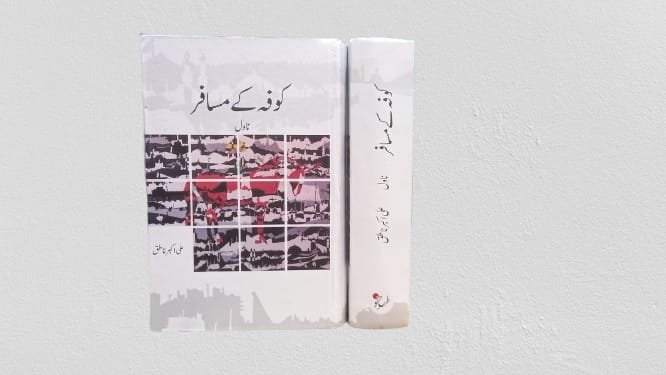
Ali Akbar Natiq is among the most distinguished contemporary Urdu novelists. He first captured the attention of serious readers with his debut short story collection, Qaim Deen, published by Oxford University Press Pakistan in 2012. Since then, he has established himself as a major literary voice through three acclaimed novels. His first novel, Naulakhi Kothe, remains his best-known work. Its English translation by Naima Rashid was published by Penguin India in 2023. His second novel, Kamari Wala, further strengthened his reputation, while his latest work, Kufa Kay Musafir (The Travellers of Kufa), has been published simultaneously in Pakistan and India. In Pakistan, it appears under Natiq’s own publishing initiative, Tarh-e-Nau, while India’s Metrolink has published the Indian edition.
The late Shamsur Rahman Faruqi, one of the most respected critics of Urdu literature, wrote of Natiq:
«”While reading Natiq’s prose, a reader discovers his mastery over the hidden recesses of Urdu narration and dialogue. His reader feels enriched and informed about the complex ties of human nature with human relationships and the points of affiliation and adversity among human beings.”»
The title Kufa Kay Musafir immediately suggests its historical setting. Kufa occupies a unique place in Islamic history and literature. Beyond being a geographical location, it has evolved into a powerful literary metaphor. Traditional historical narratives have often portrayed Kufa negatively, particularly in connection with the period of the Fourth Caliph and the tragedy of Karbala, while its more positive dimensions have received comparatively little attention.
The novel traces events from Yazid’s assumption of the caliphate following the death of Amir Muawiya to the martyrdom of Hazrat Imam Hussain (A.S.) at Karbala. Natiq reconstructs this defining period with remarkable historical and geographical awareness. His fictional elements remain carefully restrained, enhancing rather than distorting historical reality.
To achieve this authenticity, Natiq personally travelled across the regions associated with the novel, gathering firsthand knowledge while consulting a wide range of historical and cultural sources. Such dedication reflects the standards expected of a serious realist writer and significantly enhances the novel’s credibility.
The story unfolds during one of the most critical periods in Muslim history, when the institution of the Caliphate gradually transformed into hereditary monarchy. According to the novel’s perspective, political propaganda blurred the distinction between truth and falsehood for many Muslims, allowing deviation to spread. Against this backdrop, Imam Hussain (A.S.) rose in resistance, following the path earlier demonstrated by his father, Hazrat Ali (A.S.), and in accordance with the guidance of the Prophet Muhammad (PBUH). The novel presents this struggle as a defence of justice and moral integrity.
Over the past several decades, readers have developed an increasing interest in historical narratives presented through fiction. Kufa Kay Musafir answers that demand with remarkable confidence. Natiq successfully transforms historical material into compelling literature without sacrificing authenticity.
Beyond history, the novel vividly recreates the culture, traditions, and everyday life of Arabia and the Hijaz. Readers familiar with the historical events will appreciate the richness of these cultural details, while newcomers will find themselves immersed in an authentic historical world.
One of the novel’s strengths is its narrative structure. Rather than beginning with a lengthy historical introduction, Natiq assumes a reasonably informed readership and gradually reveals essential background through the unfolding story. This technique maintains narrative momentum and keeps the reader engaged. At times, however, his direct style may appear unusually plain, reducing some of the emotional subtlety. Some critics may interpret this as authorial bias, but it seems more accurate to view it as a consequence of Natiq’s commitment to realism and purposeful storytelling. Indeed, purpose is the very soul of Kufa Kay Musafir.
The progression of events is so visually structured that the novel seems naturally suited for adaptation into a television drama. Such a production could effectively fulfil the author’s broader educational and literary objectives. Islamic history has previously inspired several successful screen productions, including The Message (Al-Risalah), the Iranian series on the life of Imam Ali (A.S.), and the celebrated historical drama Mukhtar Nama. Kufa Kay Musafir possesses similar dramatic potential.
For readers interested in historical fiction, Islamic civilisation, cultural history, and the literature of resistance and martyrdom, Kufa Kay Musafir is essential reading. It offers both the pleasure of literary fiction and an opportunity to revisit one of the most significant chapters of Islamic history.
Just as Islamic history records that Hazrat Ali (A.S.) alone possessed the courage to confront the Kharijites on the battlefield, one may similarly argue that few contemporary novelists would dare to fictionalise such a sensitive and controversial historical period. Through this work, Ali Akbar Natiq demonstrates not only literary excellence but also considerable intellectual courage.
As Mirza Ghalib wrote:
«”Who stands to challenge the man-overthrowing wine of love?
The cupbearer’s invitation rises to the lips anew, after me.”»
Kufa Kay Musafir is not merely a story of determination, sacrifice, and resistance. Its very creation represents an act of truth-telling and literary courage. It belongs not only to the tradition of protest literature but extends into the broader realm of resistance literature (Muzahamati Adab).
For every serious reader interested in fiction, history, religion, and civilisation, Kufa Kay Musafir offers a rewarding and intellectually enriching experience.
About the Reviewer:
Khurram H. Khiraam Siddiqui is a poet, translator, editor, English teacher, and Chairman of the Pakistan English Foundation. Born in Multan in 1976, he earned a Master’s degree in English Literature from Bahauddin Zakariya University, graduating with distinction in American Literature.
After teaching English for a decade, he joined the Pakistan Academy of Letters (PAL), Islamabad, as its first regular English Editor. From 2006 to 2012, he edited the Academy’s English literary journal Pakistani Literature. During his tenure, he facilitated a significant literary exchange between the Pakistan Academy of Letters and the National Endowment for the Arts, Washington, D.C., resulting in the publication of two important anthologies: Modern Poetry of Pakistan and Contemporary American Poetry (2009–2010).
His published works include the English poetry collection Message of Quaid (2001) and the Urdu poetry collection Hayat-i-Nau (2009). He is currently based in Islamabad.
About The Author