
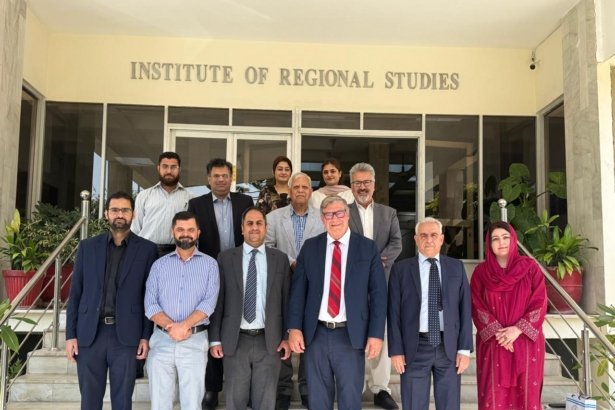

Professor Kenneth M. Holland says trade, critical minerals, technology and educational exchanges could provide Pakistan and the United States with a more sustainable foundation for bilateral relations.
Islamabad: Pakistan and the United States should build a more sustainable relationship around trade, critical minerals, technology and educational exchanges rather than relying primarily on security cooperation, Professor Kenneth M. Holland said at a discussion in Islamabad.
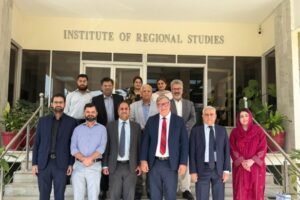
Holland, a Fulbright Specialist and adjunct professor of political science at the University of Utah, spoke at a session titled “Pakistan–US Relations in a Multipolar World,” hosted by the Institute of Regional Studies’ China Program under its Eminent Speaker Series.
He said economic cooperation could help both countries pursue shared interests while allowing Pakistan to diversify its international partnerships and maintain strategic autonomy amid growing competition among major powers.
Opening the session, Nabila Jaffer, a research analyst at IRS, said Pakistan-US relations were evolving as competition among the United States, China and Russia intensified and middle powers assumed a more prominent role in international affairs. She raised the question of whether bilateral ties could become more firmly rooted in trade, investment, education and technology.
Holland contrasted the foreign policy approaches of former President Joe Biden and President Donald Trump, describing Biden as continuing the post-World War II tradition of promoting democracy and free markets, while Trump adopted a more transactional, “America First” approach. Drawing on his work in Afghanistan, Myanmar and other countries, Holland said the US record on nation-building had been mixed, citing Germany, Italy and Japan as examples of successful efforts alongside less successful interventions.
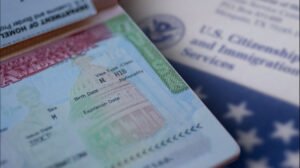
He placed bilateral relations within the broader context of US-China strategic competition, noting that Washington views India as an important partner in countering China. According to Holland, Pakistan’s strategic relevance can increase when US-India relations face tensions. He cited disputes in 2026 involving tariffs, visa restrictions and market access as factors shaping the relationship.
Counterterrorism remains an area of shared interest, particularly because of the threat posed by Islamic State Khorasan Province, or ISIS-K, Holland said. Regarding the China-Pakistan Economic Corridor, he said Washington did not oppose its economic objectives but remained concerned about potential military applications.
Critical minerals and technology offer additional opportunities. Holland noted that Pakistan has substantial mineral resources and that US companies have begun work involving antimony and copper. He also highlighted Pakistan’s educated, English-speaking young workforce as a potential asset in artificial intelligence-related services.
He said stronger US private-sector investment could help Pakistan diversify its economic partnerships and avoid excessive dependence on China. He also stressed the need to develop higher-value-added exports and strengthen electricity and internet infrastructure to support economic cooperation.
Discussing regional connectivity, Holland referred to Russia’s interest in an energy corridor linking Central Asia with South Asia, as well as the Turkmenistan-Afghanistan-Pakistan-India gas pipeline and the Trans-Afghan Railway. He also highlighted Afghanistan’s growing engagement with India, including potential trade links through Iran’s Chabahar port.
Holland pointed to improving trust between Islamabad and Washington, citing Pakistan’s role in mediation between the United States and Iran. He also underscored educational exchanges, noting that Pakistan hosts the world’s largest Fulbright program, implemented in partnership with the Higher Education Commission. The number of Fulbright Ph.D. scholarships for Pakistanis has increased from 33 to 66, he said.
In his concluding remarks, Holland said the two countries shared important interests but retained divergent priorities, particularly regarding China and India. Managing those differences would require skilful diplomacy.
IRS Research Fellow Usman Chohan highlighted emerging areas of economic cooperation, including digital assets and a liquidity arrangement under discussion between the two countries.
The session concluded with questions on the future of Pakistan-US relations, regional connectivity projects such as CASA-1000 and TAPI, the Trans-Afghan Railway, and Pakistan’s historic role in facilitating the opening of US-China relations in the 1970s.
About The Author