

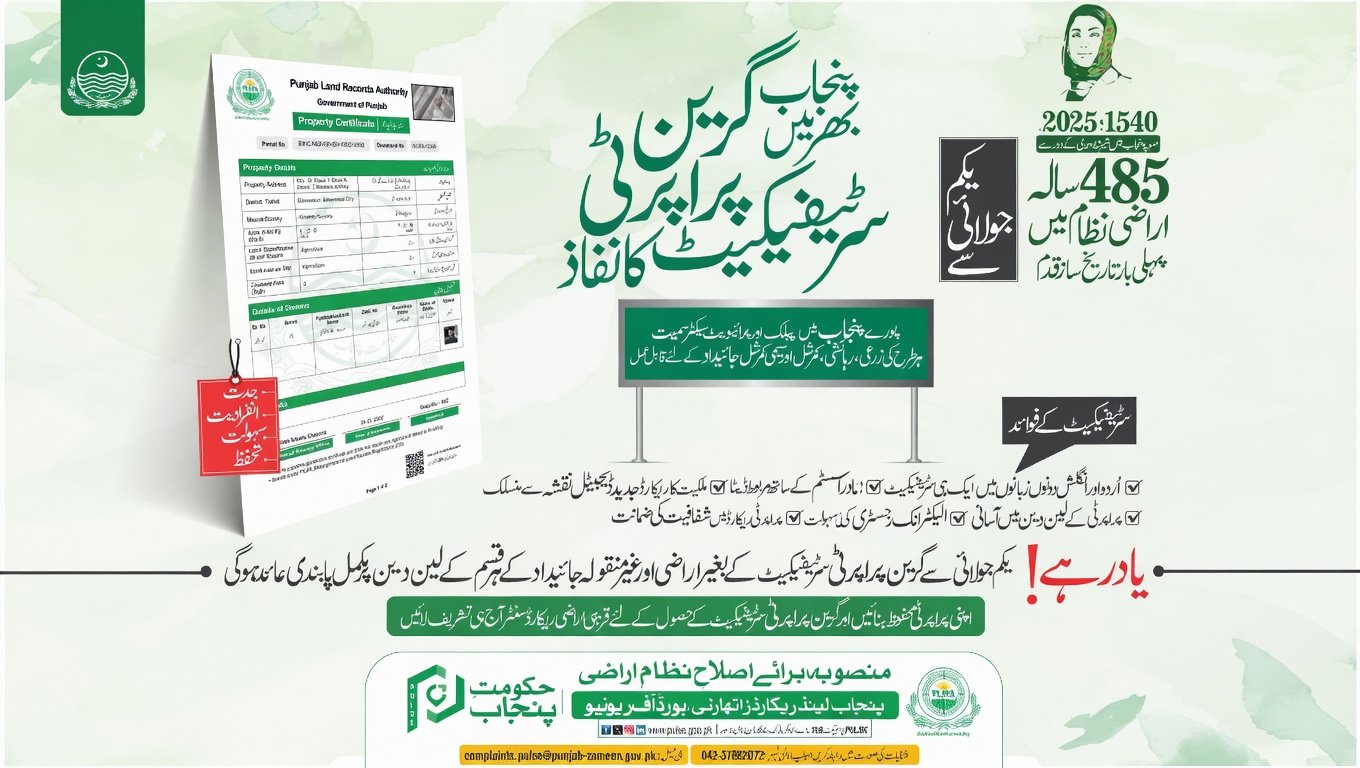

New Digital Land Reform Aims to End Fraud, Ensure Verified Ownership, and Reshape Real Estate Transactions in Punjab
Punjab has officially rolled out a major land governance reform titled the Green Property Certificate system, introducing strict verification requirements for all property and real estate transactions across the province. According to official policy details reflected in government communications and land record updates, the initiative is designed to eliminate fraudulent land dealings, improve transparency, and create a centralized digital ownership verification framework.
The development marks one of the most significant structural changes in Punjab’s property registration ecosystem in recent years, with authorities linking all future transactions to verified digital land records maintained by the Punjab Land Records Authority (PLRA).
What the Green Property Certificate System Means
The Green Property Certificate is a government-issued verification document that confirms legal ownership of a property after validation through official land record databases. It integrates ownership data with national identity records, reducing the risk of forged documents or disputed claims.
Under this system, property details are cross-checked through digital records, ensuring that only legally verified owners can proceed with buying, selling, or transferring property rights. The certificate essentially acts as a safeguard mechanism in real estate transactions.
Government material and implementation updates indicate that the system is part of a broader digital transformation of land administration, shifting away from manual paperwork toward automated verification processes.
Key Restriction: Transactions Without Certificate
The newly announced directive states that from July 1, property and non-movable asset transactions without a Green Property Certificate will not be permitted. This effectively makes the certificate a mandatory prerequisite for land-related dealings.
Officials describe the measure as a compliance step to ensure that every transaction is backed by verified ownership data, reducing the possibility of illegal sales, fake registries, or overlapping claims.
In practical terms, buyers and sellers will now be required to present a valid Green Property Certificate before completing any transfer process in the official land record system.
How the System Works
The verification process is carried out through Land Record Centers (ARCs), where applicants submit ownership documents, CNIC details, and property records. These are then verified against PLRA databases.
Once validation is completed, a Green Property Certificate is issued, confirming that:
- The property exists in official government records
- Ownership details are verified and authenticated
- No disputed claims are attached to the land
This digital integration aims to streamline property transactions and reduce dependency on manual verification systems that have historically been prone to delays and manipulation.
Why the Reform Matters
Punjab’s real estate sector has long struggled with issues such as land grabbing, fake documentation, inheritance disputes, and unclear ownership chains. These problems have not only affected individual buyers but also slowed down investment in the property market.
The introduction of a standardized verification certificate is intended to address these systemic challenges. By centralizing data and enforcing digital validation, authorities expect a reduction in legal disputes and an increase in investor confidence.
Property experts note that such reforms typically improve transparency in developing real estate markets, especially where informal transactions have historically dominated.
Impact on Property Buyers and Investors
For citizens, the immediate impact is procedural but significant. Every property transaction will now require additional verification steps before final approval. While this may initially slow down processes, officials argue that it will ultimately create a safer and more reliable market environment.
Real estate investors are also expected to benefit from increased certainty regarding ownership history and legal status of properties. Verified records can help reduce risks associated with litigation and fraudulent sales.
Banks and financial institutions may also integrate the certificate into loan approval processes, potentially making property-backed financing more secure.
Digital Governance Push in Punjab
The Green Property Certificate initiative is part of a wider shift toward digitization in Punjab’s governance system. The province has been steadily modernizing land records, introducing online verification systems, and linking databases with national identity infrastructure.
This transition is aimed at reducing human intervention in sensitive records and minimizing opportunities for corruption or manipulation.
Authorities have described the reform as a long-term investment in administrative efficiency and public trust.
What Happens Next
As the system becomes fully enforced, citizens will be required to obtain certification before engaging in any formal property transaction. Land record centers across Punjab are expected to handle increased application volumes in the coming months.
Officials are also likely to expand awareness campaigns to ensure that property owners understand documentation requirements and verification procedures.
While challenges related to implementation and public adaptation are expected, the policy marks a decisive step toward digitized land governance in the province.
About The Author