
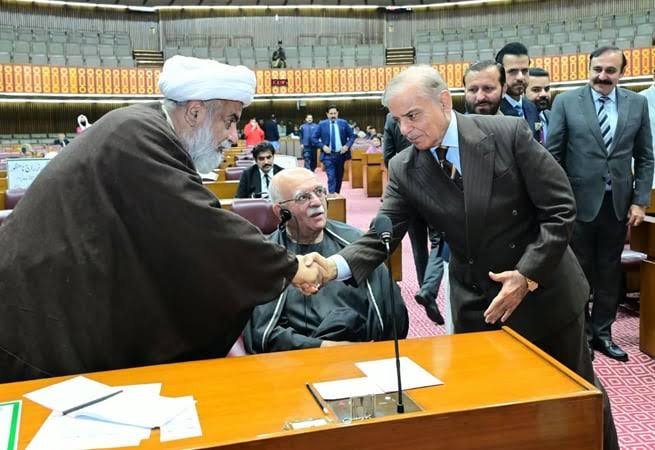

Parliament endorses presidential proclamations under Articles 232 and 234 as the government cites security concerns and opposition leaders challenge the decision.
Parliament’s joint sitting on Thursday approved presidential proclamations imposing a state of emergency and governor’s rule in Khyber Pakhtunkhwa for an initial period of two months, despite strong protests from opposition lawmakers who opposed the suspension of the PTI-led provincial administration.
The joint sitting ratified the emergency proclamation issued by President Asif Ali Zardari under Article 232 of the Constitution and approved governor’s rule under Article 234. Opposition members protested the decisions and tore up copies of the resolutions. The session, chaired by National Assembly Speaker Ayaz Sadiq, ended with an indefinite adjournment.
The approvals formalized the constitutional measures introduced on Oct. 11. The federal government has defended the move by citing the deteriorating security situation and alleged shortcomings in coordination between provincial and federal authorities on counterterrorism.
Under the relevant constitutional provisions, the proclamations can remain in force for two months following parliamentary approval. Any extension requires another resolution of the joint sitting, while the measures cannot remain in force for more than six months.
Government cites security concerns
Federal Minister for Parliamentary Affairs Tariq Fazal Chaudhry presented the proclamations before lawmakers and moved a motion to suspend certain procedural rules to facilitate the proceedings. The motion passed by 214 votes to 56 despite objections from opposition members.
Law Minister Azam Nazeer Tarar described the emergency as a last resort, saying the federal government had reviewed security reports and held detailed discussions in the federal cabinet before making its recommendation.
Tarar told lawmakers that the KP governor had sent a detailed letter to the president and prime minister warning of worsening security conditions. He said the cabinet discussed the matter for about two and a half hours before recommending that the prime minister advise the president to invoke the relevant constitutional provisions.
The minister maintained that the decision was constitutional and should not be equated with martial law. He also said the government was prepared to answer questions about the evidence and circumstances behind the proclamations.
Referring to casualties in incidents in Tank and Bajaur, Tarar criticized the provincial leadership’s handling of security matters. He also cited discussions at apex committee meetings, which he said had highlighted weaknesses in the Counter Terrorism Department’s institutional structure and resources.
Tarar said the National Assembly and Senate had separately considered the emergency proclamation before the matter reached the joint sitting. He described parliamentary scrutiny as an important constitutional safeguard and emphasized that lawmakers had the authority to examine whether the measures complied with the Constitution.
Achakzai questions security policy and provincial rights
National Assembly Opposition Leader Mahmood Khan Achakzai challenged the government’s security narrative, questioning why militants continued to enter Pakistan despite the construction of a high-security fence along the Afghanistan border.
Achakzai argued that the country’s security challenges were also linked to internal weaknesses and past policy decisions. He called for greater parliamentary supremacy, respect for constitutional limits and protection of provincial rights.
He accused authorities of mistreating opposition members and alleged that the PTI-led provincial leadership had been unlawfully detained. He also questioned restrictions on meetings with PTI founder Imran Khan, calling for political disputes to be resolved through dialogue rather than force.
Achakzai offered unconditional negotiations within the constitutional framework and urged political parties committed to democracy to form an alliance. He also stressed that the rights of Seraiki, Sindhi, Pashtun and Baloch communities over their resources must be protected.
Addressing militancy, he called for an end to reliance on weapons and coercive measures, urging political leaders to work toward eliminating terrorism. He also questioned the legitimacy of the Feb. 8 election results and challenged government lawmakers to swear that they had genuinely won their seats.
PTI rejects emergency and governor’s rule
PTI Chairman Barrister Gohar Ali Khan rejected the federal government’s decision and demanded the withdrawal of allegations linking his party to terrorism.
Speaking during the joint sitting, Gohar said PTI condemned terrorism in all its forms and had never supported militant activities. He argued that portraying the party as supportive of terrorism threatened national unity and could have consequences beyond Pakistan.
Gohar said the armed forces belonged to the country and reaffirmed PTI’s commitment to Pakistan. He also criticized the suspension of the provincial government, describing it as an extreme step taken amid political differences.
The PTI chairman categorically rejected the emergency proclamation, governor’s rule and the decision to deploy the army in KP. He said the party would continue to challenge the measures and work toward a country where those responsible for wrongdoing would be held accountable.
The parliamentary approval formalizes the federal government’s intervention in KP, while the opposition’s objections highlight continuing disputes over security policy, provincial autonomy and the constitutional limits of federal authority.
About The Author