
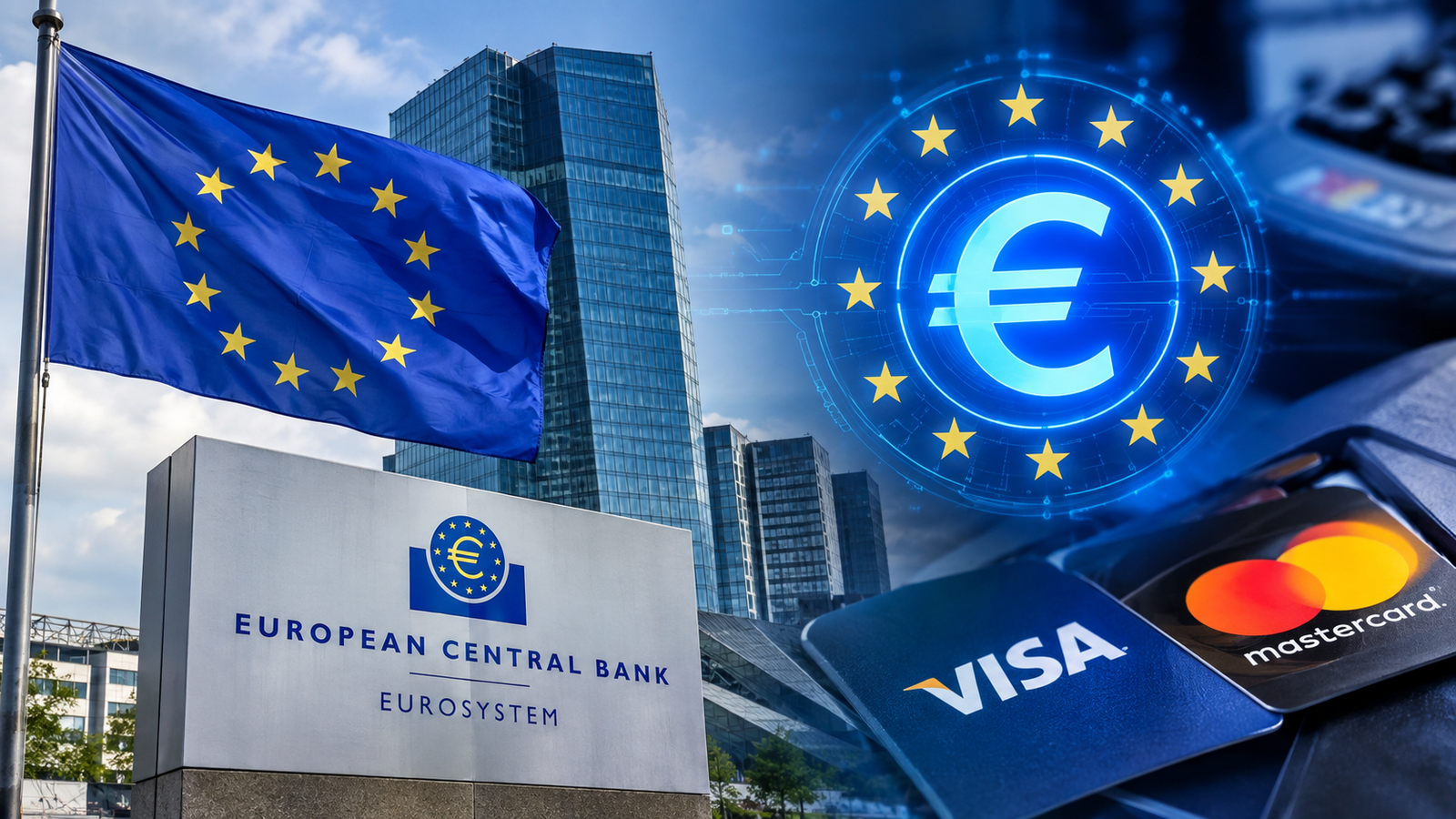

The European Union is advancing a digital euro as policymakers seek greater control over payment infrastructure and less dependence on U.S.-based card networks.
Europe’s growing dependence on U.S.-based payment networks has come under renewed scrutiny as the European Union advances plans for a digital euro designed to provide a European alternative for everyday payments.
Visa and Mastercard play a dominant role in the European card-payment market. The European Central Bank said international card schemes accounted for about 61% of euro-area card transactions in 2022, while ECB officials have more recently cited a figure of about 65% for euro-area card payments.
The geopolitical implications of that dependence became particularly visible after the United States imposed sanctions on officials of the International Criminal Court.
On Aug. 20, 2025, the U.S. sanctioned four ICC judges, including French judge Nicolas Guillou, in a move Washington linked to the court’s actions involving Israel and the United States. Guillou had authorized the issuance of arrest warrants for Israeli Prime Minister Benjamin Netanyahu and then-Defense Minister Yoav Gallant.
Guillou later described the practical impact of the sanctions, saying he was unable to use Visa and Mastercard cards and that restrictions extended to other services provided by U.S.-linked companies. His experience highlighted how U.S. sanctions can have consequences beyond American territory when individuals rely on globally dominant companies based in the United States.
The episode has become part of a wider European debate over what policymakers describe as payment sovereignty. The ECB has warned that reliance on foreign payment providers can create strategic vulnerabilities, while the European Commission and EU governments have backed the development of European payment alternatives.
The proposed digital euro would be issued by the European Central Bank as a form of central bank money and would complement cash rather than replace it. Users would be able to make digital payments through participating banks and payment providers, with the system designed to operate across the euro area.
The European Parliament’s economic committee approved its position on the digital euro proposal in June 2026 by 43 votes to 14, with one abstention. Further legislative negotiations are required before the system can become operational.
The ECB has selected payment-service providers for a pilot scheduled to begin in the second half of 2027. A full rollout is currently expected in 2029, subject to the completion and approval of the necessary legislation.
The digital euro therefore would not immediately eliminate Visa or Mastercard from Europe. Instead, its proposed role is to give consumers and businesses a European alternative while reducing the bloc’s dependence on foreign payment infrastructure and strengthening the resilience of the euro area’s payments system.
About The Author