
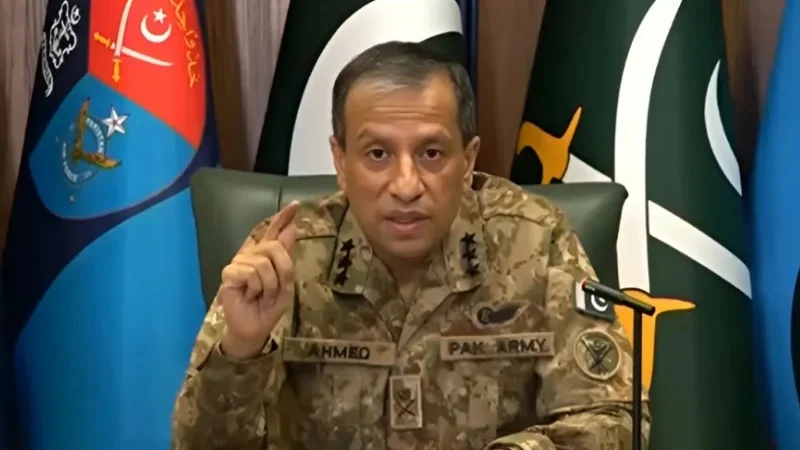

DG ISPR Lieutenant General Ahmed Sharif Chaudhry says Pakistan will fulfil its defence commitments to Saudi Arabia while urging diplomatic efforts to prevent further regional escalation.
ISLAMABAD: Pakistan is prepared to take all necessary defensive measures to protect Saudi Arabia amid rising regional tensions, Director General Inter-Services Public Relations (DG ISPR) Lieutenant General Ahmed Sharif Chaudhry has said, reaffirming Islamabad’s commitment to the Kingdom’s security, sovereignty and territorial integrity.
In an interview with a Saudi newspaper on Wednesday, Chaudhry said Pakistan’s response would be guided by the prevailing regional situation, the Joint Strategic Defence Agreement between the two countries and their commitments under the Makkah Joint Defence Agreement.
He stressed that Pakistan’s support for Saudi Arabia was non-negotiable, particularly regarding the protection of its territory and the Two Holy Mosques.
His remarks come amid heightened tensions in the Middle East following missile and drone attacks by Yemen’s Houthi group on Saudi Arabia. The reported strikes have caused casualties and injuries and raised concerns about the safety of civilian populations and critical energy infrastructure.
Chaudhry said the Makkah Joint Defence Agreement (MJDA) was moving towards the practical implementation of its collective defence commitments. This would involve arrangements for the timely deployment of agreed military forces and capabilities inside Saudi Arabia.
He identified operational readiness, closer military integration, intelligence-sharing arrangements and coordination of defensive operations as key components of the implementation process.
Regarding Pakistan’s existing military presence in Saudi Arabia, the military spokesperson said Pakistani personnel were already serving in the Kingdom, primarily providing defensive assistance and participating in joint military exercises and training programmes.
He added that Islamabad would continue providing necessary support through military personnel, equipment, training and logistical assistance.
Asked whether Pakistan would increase its troop deployment or provide additional capabilities, including air and missile defence systems, Chaudhry indicated that the required assistance would continue. However, he declined to disclose specific troop numbers, deployment locations or operational arrangements, saying such information was not publicly shared under military agreements.
The DG ISPR said attacks targeting Saudi cities, airports and civilian and economic infrastructure had reinforced the need to implement existing defence commitments. He described such strikes as a serious threat to the Kingdom’s sovereignty and regional stability.
At the same time, he called for restraint, diplomatic engagement and efforts to prevent further escalation, warning that an expansion of regional hostilities would benefit no country.
Discussing diplomatic initiatives, Chaudhry referred to an October 26 meeting between representatives of the Makkah defence framework and Iran in Tehran. He said the discussions aimed to establish a mechanism for reducing tensions and strengthening regional cooperation.
He added that the participation of Chief of Defence Forces and Chief of Army Staff Field Marshal Asim Munir, following his earlier visit to Tehran, reflected Pakistan’s commitment to dialogue and peaceful conflict resolution.
Chaudhry also explained the distinction between Pakistan’s bilateral defence agreement with Saudi Arabia and the trilateral arrangement involving Türkiye.
He said the Joint Strategic Defence Agreement between Islamabad and Riyadh provided a framework for mutual security assistance and deeper military cooperation in response to aggression against either country.
The Makkah Joint Defence Agreement, meanwhile, brought Pakistan, Saudi Arabia and Türkiye together under a broader framework covering collective defence, military preparedness and operational coordination.
The three countries formalised their trilateral defence partnership on August 7. According to the supplied information, the agreement provides that an armed attack against any one of the three countries would be treated as an attack against all three.
Chaudhry emphasised that both defence arrangements were strictly defensive and did not involve offensive intentions against any country. He said the partnership aimed to strengthen collective deterrence, expand military cooperation and contribute to regional peace and stability.
About The Author