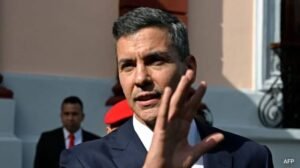

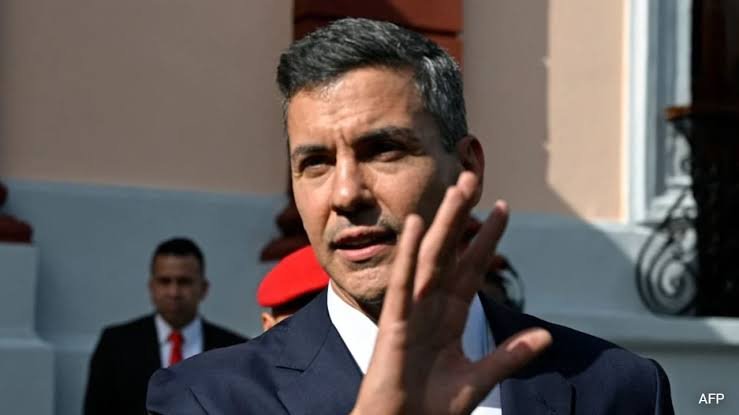

Paraguay’s Senate unanimously removes Santiago Peña over allegations linked to Ueno Bank’s financial crisis, as Vice President Pedro Alliana assumes the presidency.
ASUNCIÓN: Paraguay’s Senate has impeached and removed President Santiago Peña from office following a major banking crisis that froze the accounts of nearly 3 million customers, triggering nationwide protests and allegations of political interference in financial regulation.
Vice President Pedro Alliana was sworn in as Paraguay’s new president on Friday, Nov. 6, and will complete Peña’s remaining presidential term, which runs until August 2028.
All 44 senators present voted in favour of removing Peña, while one member of the 45-seat Senate was absent. Lawmakers found him guilty of poor performance in office over allegations connected to the financial crisis surrounding Ueno Bank.
Shortly after his removal, prosecutors ordered Peña placed under house arrest on suspicion of breach of trust. He was directed to remain at his residence until appearing before the Attorney General’s Economic Crimes and Anti-Corruption Unit.
The impeachment proceeded despite Peña offering to resign a day earlier. Lawmakers chose to complete the removal process, preventing him from obtaining the lifetime Senate membership and parliamentary immunity normally available to former presidents under Paraguay’s constitution.
Peña did not attend the Senate trial. His lawyers argued that he had insufficient time to prepare his defence and challenged the proceedings, reserving the right to appeal to the Supreme Court and international human rights bodies.
Ueno Bank crisis sparks political upheaval
The crisis began when Paraguay’s Central Bank took control of Ueno Bank on Tuesday, Nov. 3, amid concerns about its financial position and alleged violations of minimum solvency requirements. The intervention froze customers’ accounts and bank cards, affecting nearly 3 million people.
Ueno had expanded rapidly through its digital banking model, providing financial services to customers who previously had limited access to traditional banking.
However, the institution’s financial difficulties raised questions about its political connections and the handling of public funds.
Peña previously held shares in Grupo Vazquez, the conglomerate controlling Ueno Bank. He said he sold his stake last year. Lawmakers nevertheless accused him of a conflict of interest and using political influence to direct public money towards the lender.
The impeachment charges also included allegations of inadequate regulatory oversight and concerns about the appointment of former Ueno executive Carlos Carvallo as Central Bank chief.
Lawmakers questioned deposits made by the state pension fund, which reportedly exceeded legal limits. According to the Associated Press, Ueno received more than $800 million in public funds, including approximately $355 million from the state pension fund.
Peña denied wrongdoing and apologised to the public in a televised address. He said he had never intended to betray public trust and described his departure as an effort to prevent further political divisions.
Protests, investigations and financial recovery
The banking crisis triggered several nights of demonstrations in Asunción and other cities. Thousands of people demanded access to their savings and accountability from those responsible. Police used tear gas and water cannons to disperse demonstrators in the capital on Thursday.
Authorities have begun releasing advance payments to eligible depositors. The initial phase provides payments of up to approximately $1,600 to qualifying customers.
The Central Bank has said its deposit guarantee scheme protects balances of up to approximately $37,000 per customer, with coverage expected to include nearly all Ueno customers.
Meanwhile, prosecutors have launched three criminal investigations examining the bank’s operations, regulatory supervision and management of public funds.
Twenty-seven people, including controlling shareholder Miguel Vazquez and several executives, have been charged in connection with suspected financial crimes. Authorities have also ordered the arrest of former Central Bank chief Carvallo.
The scandal has affected businesses beyond the banking sector. Around 1,000 employees of technology company ITTI in neighbouring Argentina were reportedly suspended for 30 days without pay.
The crisis has also exposed divisions within the ruling Colorado Party. Former president Horacio Cartes, a powerful party figure and Peña’s former political patron, supported his removal.
Alliana now faces the task of restoring confidence in the government and financial system while investigations continue. He is also facing scrutiny over alleged connections to the scandal, although an opposition effort to impeach him was shelved.
About The Author