

CEPA comes into force on 1 May 2026, cutting tariffs on over 91% of goods and setting the stage for a powerful Gulf–Asia economic corridor.
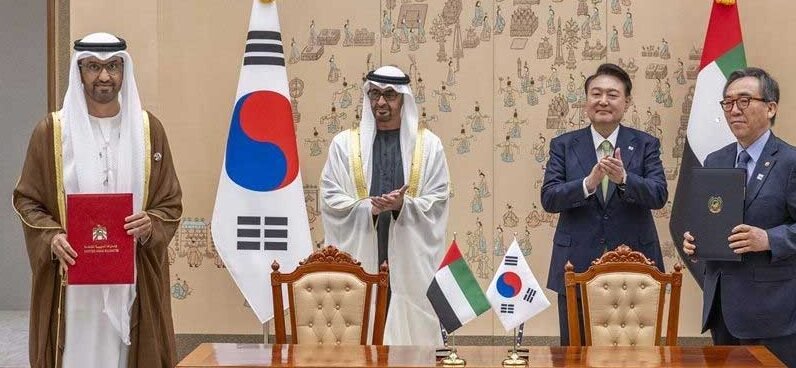
A major shift in global trade dynamics has begun as the Comprehensive Economic Partnership Agreement between United Arab Emirates and South Korea officially came into effect on 1 May 2026, unlocking one of the most ambitious economic frameworks linking the Gulf and East Asia in recent years.
The agreement immediately reduces or removes tariffs on 91.2 percent of traded goods and services, a move expected to reshape supply chains and dramatically expand market access for businesses on both sides. With $6.9 billion in non-oil trade already recorded in 2025, the new framework is positioned to accelerate that figure sharply in the coming years.
For the UAE, the deal strengthens its long-standing strategy to diversify beyond hydrocarbons and deepen global economic integration under its Vision 2031 agenda. For South Korea, it marks its first comprehensive trade agreement with any country in the Middle East and North Africa region, opening a strategically important gateway into Gulf markets.
Key sectors expected to benefit include energy, advanced manufacturing, renewable technologies, logistics, healthcare, and digital innovation. Analysts say the agreement is likely to encourage joint ventures, cross-border investment, and technology transfer, especially in high-growth industries tied to future energy transitions.
Beyond tariff reductions, the CEPA is being viewed as a structural economic bridge between two rapidly evolving economies. It aims to strengthen private sector collaboration and build more resilient supply chains at a time when global trade is facing disruption from geopolitical tensions and technological shifts.
With implementation now underway, businesses across both nations are expected to move quickly to capitalise on new preferential trade conditions, setting the stage for what could become one of the most influential Gulf–Asia economic corridors in the coming decade.
About The Author