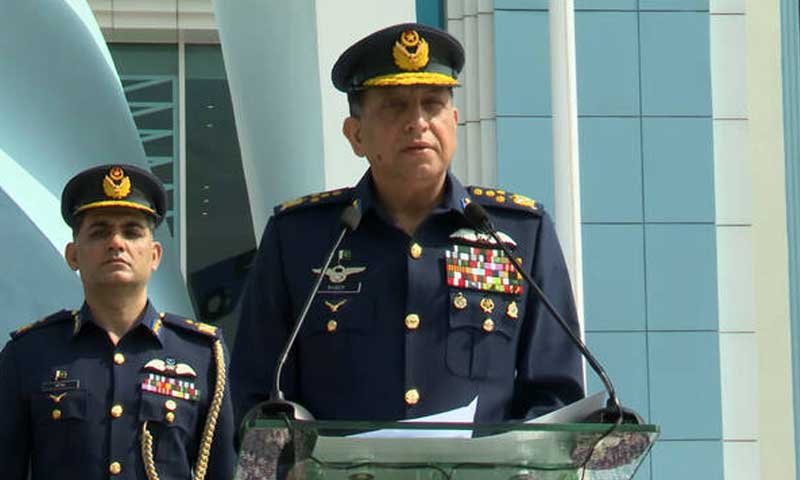

A year after the 2025 India-Pakistan crisis, Pakistan’s Air Chief Marshal Zaheer Ahmed Babar Sidhu has outlined a sweeping shift toward multi-domain warfare, warning that future conflicts in South Asia will be fought simultaneously across air, cyber, digital, and cognitive fronts.
Pakistan’s military leadership has signaled a major transformation in regional deterrence strategy, with Air Chief Marshal Zaheer Ahmed Babar Sidhu declaring that future wars in South Asia will no longer be decided by traditional air combat alone.
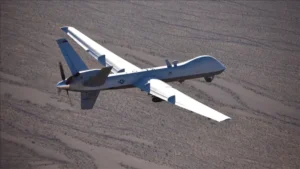
Speaking a year after the May 2025 India-Pakistan crisis, the Air Chief said modern conflict has entered a new phase where cyber operations, electronic warfare, unmanned aerial systems, artificial intelligence, and long-range precision strikes must operate within a unified military framework.
His remarks point to a broader doctrinal evolution within Pakistan’s defence structure as regional militaries increasingly adapt to rapidly advancing technologies and hybrid warfare environments.
According to the Air Chief, deterrence in a nuclearized South Asia now depends not only on kinetic military strength but also on the ability to dominate information, digital networks, and decision-making spaces during crises.
Security analysts say the shift reflects growing concern over how emerging technologies are compressing wartime decision timelines. AI-powered surveillance systems, autonomous drones, network-centric warfare capabilities, and electronic disruption tools are accelerating the speed of confrontation and increasing the risk of miscalculation between rival states.
Experts warn that future conflicts may involve simultaneous attacks across physical and digital domains, where misinformation campaigns, cyber intrusions, and electronic jamming could complicate battlefield awareness and blur escalation thresholds.
The Air Chief also stressed the importance of “calibrated restraint,” arguing that technological advancement must be matched by strategic maturity and responsible escalation control.
His comments come at a time when military planners worldwide are reassessing how artificial intelligence and autonomous systems are reshaping conventional deterrence models. In South Asia, where Pakistan and India remain nuclear-armed rivals, observers believe the integration of cyber and cognitive warfare capabilities could significantly alter crisis management dynamics.
Analysts note that while advanced military technologies may enhance operational reach and rapid response capabilities, they also raise concerns about unintended escalation, especially in situations where reaction windows become increasingly narrow.
The speech highlights a growing debate within strategic circles over whether regional stability in the coming decade will depend more on diplomatic communication mechanisms and crisis management frameworks than on the sophistication of weapons systems alone.
As geopolitical competition intensifies and military modernization accelerates across the region, Pakistan’s latest military messaging suggests that future deterrence strategies will rely on seamless coordination between conventional power, digital dominance, and information superiority.
About The Author