
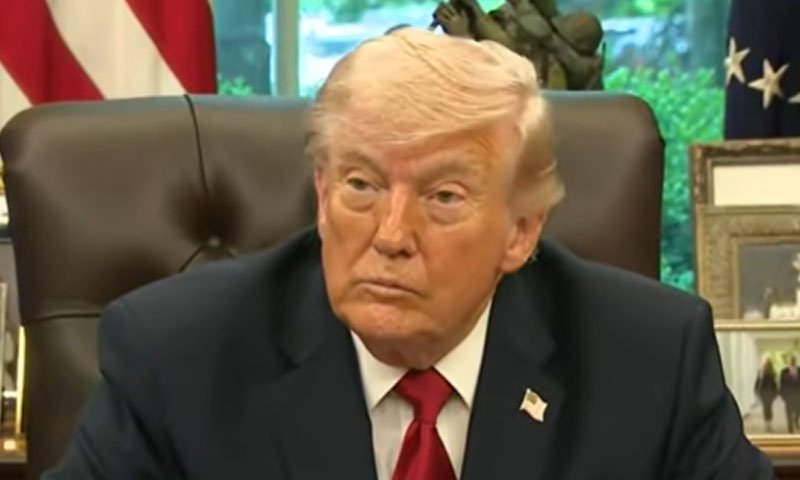

WASHINGTON: U.S. President Donald Trump has issued a stark warning to Iran, declaring that he would not remain patient “much longer” as tensions between Washington and Tehran continue to rise over nuclear activities and regional security.
In a televised interview on Fox News’ “Hannity” programme, Trump urged Iran to quickly reach an agreement with the United States, signaling growing frustration within his administration over stalled diplomacy and the fragile ceasefire that has held for just over five weeks.
“I am not going to be much more patient,” Trump said. “They should make a deal.”
The remarks come amid increasing fears of another military escalation in the Middle East following months of conflict involving the United States, Iran and Israel. While Washington continues to demand that Tehran surrender its highly enriched uranium stockpile and halt domestic uranium enrichment, Iran insists it has the legal right to pursue nuclear technology for peaceful purposes under international agreements.
Trump also appeared to downplay the strategic importance of recovering Iran’s enriched uranium reserves, suggesting the issue was largely symbolic.
“I don’t think it’s necessary except from a public relations standpoint,” he stated, adding that possessing the uranium stockpile would simply make him “feel better.”
Iranian officials responded with defiance. Parliamentary spokesman Ebrahim Rezaei warned earlier this week that Tehran could enrich uranium up to 90 percent purity — considered weapons-grade level — if the country were attacked again.
The latest exchange has intensified concerns that nuclear negotiations may completely collapse, especially as diplomatic efforts between the two sides remain deadlocked. Analysts say both Washington and Tehran are refusing to compromise on core demands, making the possibility of a formal peace agreement increasingly uncertain.
The broader regional crisis has also elevated the strategic importance of the Strait of Hormuz, one of the world’s most critical oil transit routes. Before the conflict erupted, nearly 20 percent of global oil and liquefied natural gas shipments passed through the narrow waterway.
As tensions persist, the United States has quietly sought assistance from Xi Jinping and China to help stabilise the situation and encourage safe passage through the Strait of Hormuz. However, analysts believe Beijing is unlikely to significantly pressure Tehran, viewing Iran as a key geopolitical partner against American influence.
Meanwhile, shipping traffic through the strait has slowly increased after weeks of disruption. Iranian media claimed dozens of vessels crossed the waterway in recent days under selective arrangements negotiated by Tehran with several countries, including China and Japan.
The conflict has already caused widespread devastation across the region. Thousands of people have reportedly been killed in U.S. and Israeli strikes on Iran, while renewed clashes involving the Iran-backed Hezbollah group have also triggered heavy casualties in Lebanon.
Despite the military pressure, experts say Iran still retains substantial leverage due to its geographical control over access to the Strait of Hormuz and its remaining missile and drone capabilities.
At the same time, the crisis is becoming politically sensitive for Trump ahead of crucial U.S. midterm elections scheduled later this year. Critics and human rights organisations have condemned some of Trump’s rhetoric during the conflict, including threats targeting civilian infrastructure and controversial comments regarding naval operations near Iranian ports.
Senior U.S. military officials, however, maintain that Iran’s ability to threaten neighbouring countries has been significantly weakened. Admiral Brad Cooper told a Senate committee that Tehran’s regional military capabilities had been “significantly degraded” across multiple domains.
Still, observers warn that the absence of a diplomatic breakthrough keeps the Middle East dangerously close to another major escalation, with energy markets, global trade routes and regional stability all hanging in the balance.
About The Author