

The global technology war between the United States and China has entered a dramatic new phase, as Chinese tech giant Huawei appears to have turned years of American sanctions into an opportunity for self-reliance and expansion. Meanwhile, US tech powerhouse Apple remains heavily dependent on Chinese manufacturing and supply chains, raising fresh concerns in Washington over America’s long-term strategic position in the tech industry.
For years, Huawei faced some of the toughest economic and technological restrictions imposed by the United States. Washington blacklisted the company, restricted its access to advanced semiconductors, and cut off key American technologies in an effort to weaken its global influence. However, instead of collapsing under pressure, Huawei has re-emerged stronger, more independent, and increasingly competitive in several high-tech sectors.
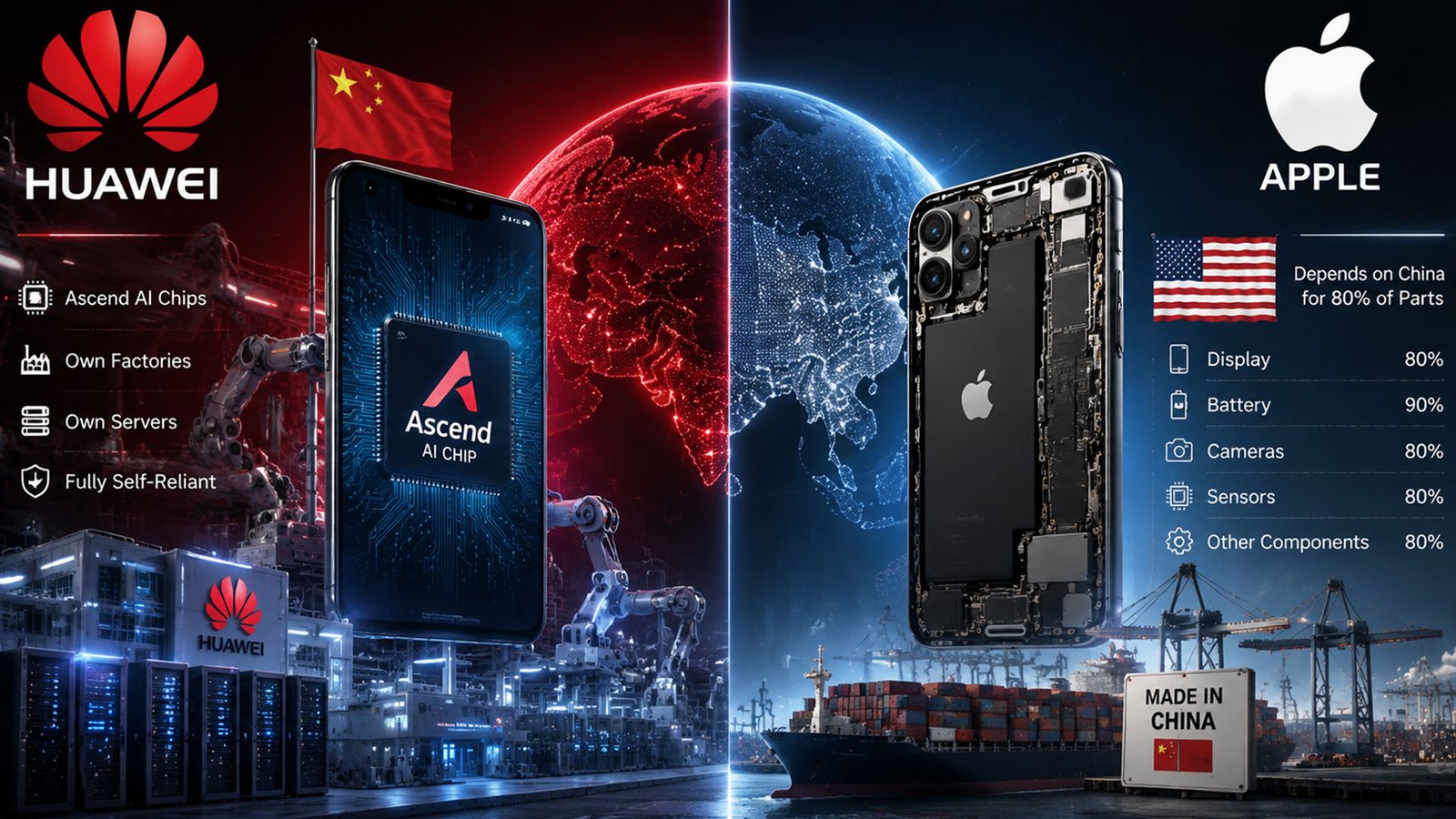
At the same time, Apple’s deep dependence on China has become a major concern for policymakers and economic strategists in the US. Industry reports indicate that nearly 80 percent of Apple’s supply chain still relies on Chinese factories and engineering expertise. Critical components used in iPhones — including advanced display panels, high-performance batteries, cameras, and sensors — are largely manufactured in China.
Apple’s efforts to diversify production through India have also faced serious operational challenges. Field reports and industry observers claim that many production facilities in India continue to depend heavily on Chinese technical expertise. In some cases, production reportedly slows or temporarily halts when Chinese engineers are unavailable, highlighting China’s dominance in advanced manufacturing and precision engineering.
Huawei, on the other hand, has accelerated its push toward technological independence. The company has developed its own artificial intelligence chips under the Ascend series, aiming to challenge American dominance in AI computing. Huawei has also expanded domestic infrastructure by building local server systems and semiconductor foundries within China.
The company shocked global markets when it launched its Mate 60 smartphone series powered by locally developed Kirin chips. The launch was widely viewed as a symbolic breakthrough because it demonstrated China’s growing capability to produce advanced chips despite strict US export controls.
Huawei has also gained significant momentum in the foldable smartphone market, where it is now considered one of the global leaders. According to recent market reports, the company recorded a sharp rise in revenue during the first half of 2026, further strengthening perceptions that US sanctions may have unintentionally accelerated China’s technological self-sufficiency.
Experts say Apple could face even greater pressure if future US policies force the company to move large-scale production from China back to the United States. Analysts warn that manufacturing iPhones entirely in America would dramatically increase labor and operational costs.
Economic estimates suggest that an iPhone currently priced around $1,200 could potentially cost between $3,000 and $3,500 if assembly operations were shifted fully to the US. Such pricing could severely impact global demand and put pressure on Apple’s market valuation and investor confidence.
The growing contrast between Huawei’s self-reliant expansion and Apple’s continued dependence on Chinese industrial infrastructure has become one of the most significant developments in the ongoing US-China technology rivalry. What was once intended to weaken Huawei now appears to have fueled China’s drive for technological independence, while America’s own flagship brand continues to rely on the very system Washington has tried to counter.
About The Author