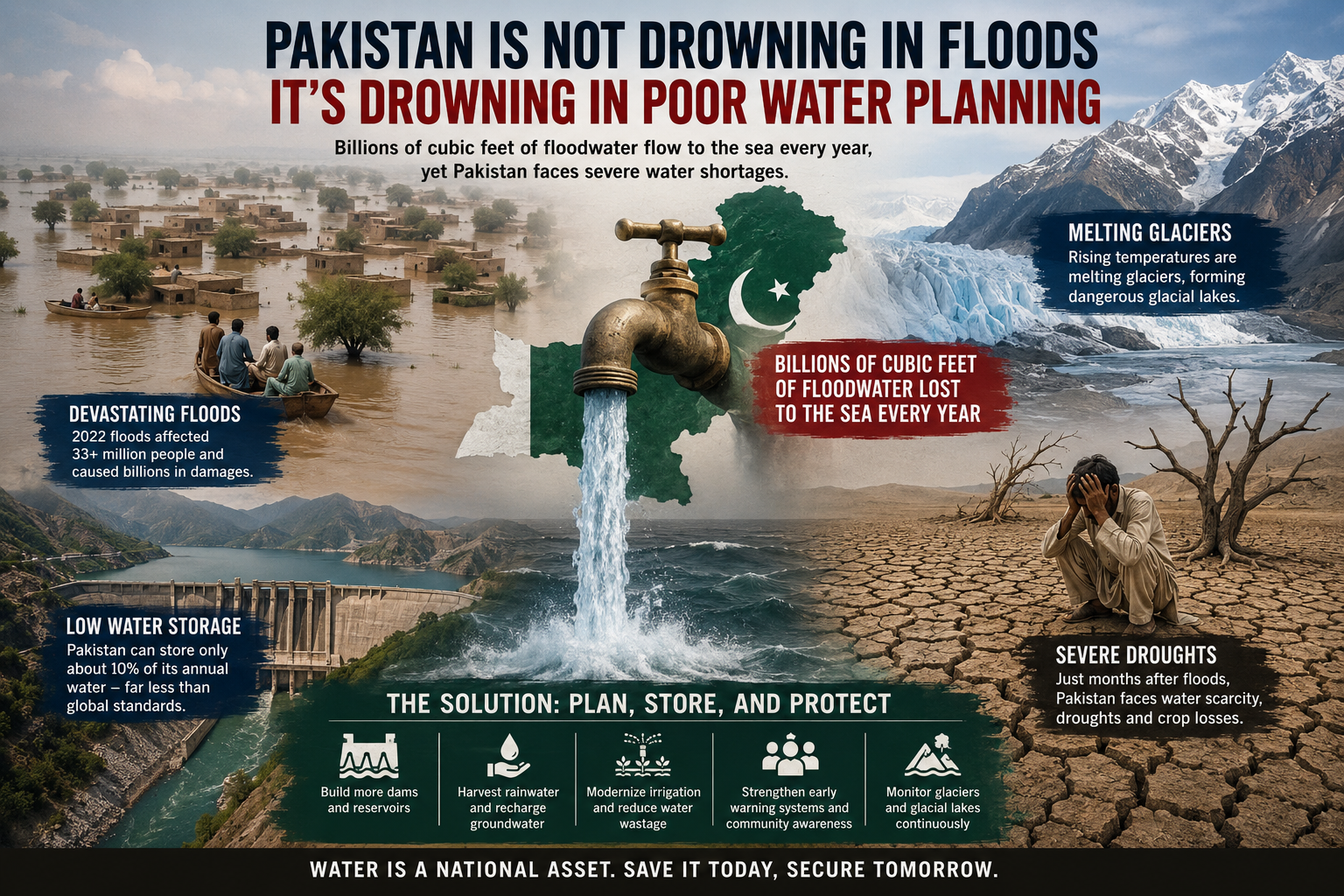

Pakistan loses billions of cubic feet of floodwater to the sea every year, only to face severe water shortages months later. Experts warn that without urgent reforms in water storage and climate adaptation, the country risks deeper environmental and economic crises.
Every year, Pakistan watches billions of cubic feet of floodwater flow into the Arabian Sea. Just months later, the country grapples with water shortages, drought, and emergency meetings over melting glaciers. The contradiction highlights a deeper national challenge: the failure to manage water as a strategic resource rather than a recurring disaster.
Climate change has intensified Pakistan’s vulnerability despite the country’s contribution of less than one percent to global greenhouse gas emissions. Rising temperatures are accelerating glacier melt in the northern regions, increasing the formation of glacial lakes and raising the risk of destructive floods. At the same time, large parts of the country face chronic water scarcity during much of the year.
Pakistan’s water system depends heavily on the Indus River. Around 41 percent of its flow comes from glaciers, 22 percent from snowmelt, 27 percent from rainfall, and only 10 percent from groundwater. Any disruption to the northern glacier system therefore threatens agriculture, energy production, food security, and livelihoods across the country.
The growing number of glacial lakes in Gilgit-Baltistan and Khyber Pakhtunkhwa has become a major concern. Satellite monitoring and scientific assessments continue to identify dozens of potentially dangerous lakes capable of triggering sudden glacial lake outburst floods, which can destroy villages, roads, bridges, and farmland within hours.
Pakistan experienced the devastating consequences in the catastrophic floods of 2022, when nearly one-third of the country was submerged. More than 33 million people were affected, millions lost homes and livelihoods, and the economy suffered billions of dollars in damage. Yet much of the floodwater eventually flowed into the sea because the country lacked sufficient storage infrastructure.
This remains one of Pakistan’s greatest policy failures. While many countries store between 30 and 40 percent of their annual water resources, Pakistan can store only about 10 percent. Existing reservoirs hold roughly 30 days of water, far below the 120-day storage capacity that water experts consider necessary. Had additional reservoirs and medium-sized dams been operational during the 2022 floods, significant volumes of water could have been preserved for irrigation, drinking water, and industrial use in drought-prone regions.
The challenge is compounded by seasonal variation. Nearly 80 percent of Pakistan’s river flow arrives between June and August. Without adequate storage during these months, the country spends the rest of the year struggling with shortages. Per capita water availability has fallen dramatically from around 5,650 cubic meters in 1951 to below 1,000 cubic meters today, placing Pakistan among the world’s water-scarce nations.
Climate change is undoubtedly worsening the situation, but poor planning has magnified its impact. Effective adaptation requires investment in infrastructure, modern irrigation systems, groundwater regulation, and long-term water governance.
Accelerating major water projects, including Diamer-Bhasha, Mohmand, Dasu, and other strategic reservoirs, should become a national priority beyond political divisions. At the same time, Pakistan must expand small dams, rainwater harvesting systems, recharge ponds, and check dams at the district level. Strengthening canal infrastructure, promoting drip irrigation, and regulating groundwater extraction are equally critical.
Continuous monitoring of glacial lakes, advanced early warning systems, community preparedness, and greater investment in climate research will also be essential to reducing future disaster risks. Climate change should no longer be viewed solely as an environmental issue but as a matter of national security, economic stability, agriculture, food security, and sustainable development.
About The Author