
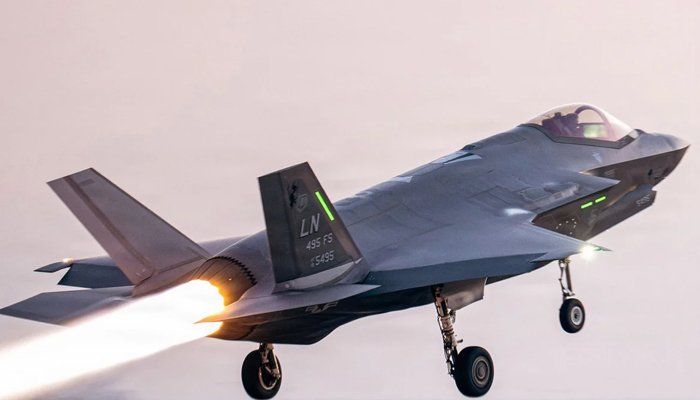

During ongoing aerial operations over Iran, reports have emerged that a US F 35 stealth fighter jet was targeted forcing it to make an emergency landing. If confirmed, this would mark the first known instance in the conflict where Iran successfully engaged one of America’s most advanced stealth aircraft.
The incident has drawn significant attention from global military observers, particularly in China, where defense analysts are studying how such a sophisticated jet could have been detected. According to Chinese media reports experts suggest that Iran may have bypassed the F 35’s radar evading capabilities by relying on electro optical and infrared (EO/IR) sensor systems.
Retired People’s Liberation Army Colonel Yue Gang noted that while the F 35 is designed to evade radar detection it remains potentially vulnerable to infrared tracking systems. These sensors detect heat signatures emitted by aircraft, which stealth technology cannot fully eliminate.
Another military analyst Song Zhongping, emphasized that EO/IR systems do not emit electronic signals, making it extremely difficult for the F 35 to detect that it is being tracked or targeted.
The incident if verified, could have significant implications for modern aerial warfare and the future effectiveness of stealth technology.
About The Author