

The Pakistan-Turkey-Saudi defense partnership could become more than a security arrangement, but its future may depend on whether it strengthens deterrence without creating a new regional confrontation.
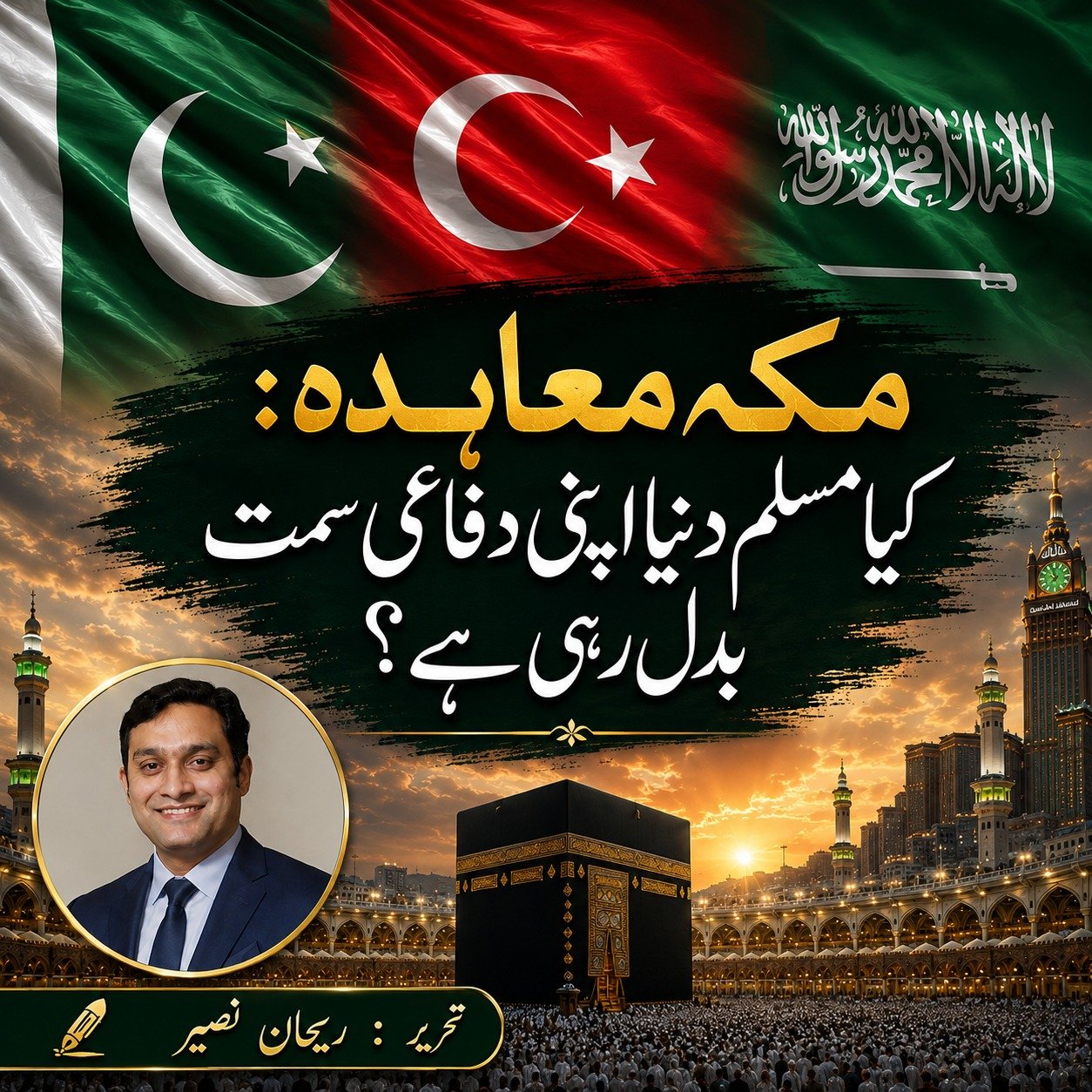
International agreements can sometimes run far deeper than the pages on which they are signed. The defense agreement involving Pakistan, Turkey and Saudi Arabia in Mecca is one such development, raising questions about regional security, shifting alliances and the future of strategic cooperation in the Muslim world.
At its core, the agreement appears to establish a framework for mutual security. But its wider significance lies in what the three countries could potentially build from it. Saudi Arabia has faced persistent security challenges in recent years, including the Yemen war, Houthi missile and drone attacks, rising Gulf tensions and the broader rivalry between Iran and Arab states.
For Riyadh, advanced weapons and economic strength alone may not provide complete security. A wider regional defense environment can also serve as a deterrent by making potential aggressors consider the consequences of targeting one country in isolation.
The unusual strength of the partnership comes from the different forms of power represented by its three members. Turkey possesses a large military, extensive operational experience and a rapidly expanding defense industry, including capabilities in drones and other defense technologies.
Pakistan brings a different strategic weight. It has a large and organized military, extensive combat experience and is the world’s only Muslim nuclear-armed state. That nuclear status inevitably carries psychological and strategic significance, although the agreement should not automatically be interpreted as providing Saudi Arabia with a Pakistani nuclear umbrella unless an explicit official nuclear or defense guarantee is announced.
Saudi Arabia contributes another form of influence: enormous economic resources, a central position in global energy markets and unique religious and political importance because of the presence of Islam’s two holiest sites.
Together, the three countries represent a combination of military strength, defense technology, nuclear capability, economic resources and strategic geography. If these assets are converted into coordinated security cooperation, the consequences could extend well beyond their borders.
Is the Mecca Pact Directed Against Iran?
The question is difficult to avoid given the current Middle Eastern environment. Iran and Saudi Arabia have a long history of strategic rivalry, while the Yemen conflict and the presence of armed groups across the region have added further complexity.
However, describing the Mecca agreement simply as an “anti-Iran alliance” could be a serious misreading.
Pakistan shares a long border with Iran and has permanent interests in trade, border security and bilateral relations. Turning the relationship into direct hostility would not serve Islamabad’s interests. Turkey also maintains economic and regional engagement with Iran alongside strategic competition in several areas.
For Pakistan and Turkey, therefore, the more sustainable approach would be to frame the defense partnership around broader regional security rather than the containment of a particular country. If it develops into a new sectarian or military bloc, it could undermine the very stability it is intended to strengthen.
Pakistan faces the most delicate balancing act. Islamabad has close strategic and economic ties with Saudi Arabia, while geography requires it to maintain working relations with neighboring Iran. Its challenge will be to support Saudi security interests without becoming part of a confrontation that could lead to direct conflict with Tehran.
Could It Become an “Islamic NATO”?
The idea is politically attractive, but it would be premature to describe the agreement as an Islamic NATO.
A NATO-style alliance requires permanent institutions, integrated military planning, clear defense obligations, joint command structures and long-term mechanisms for coordination. The Mecca agreement is not yet at that level.
Its future significance, however, could depend on whether cooperation expands into military training, intelligence sharing, cyber security, drone technology, missile defense, maritime surveillance and defense-industry partnerships.
Such developments could gradually turn a limited agreement into a broader regional security framework.
The pact could also carry significance for Washington. Gulf security has historically depended heavily on American military power, and Saudi Arabia and other Gulf states continue to maintain close defense and political ties with the United States. The new partnership should therefore not automatically be viewed as a rejection of Washington.
Instead, it may reflect a broader trend in which regional states seek greater strategic autonomy by strengthening domestic military capabilities, defense industries and regional partnerships.
The Real Test Will Come During a Crisis
The ultimate strength of the agreement will not be measured by political statements but by how the partners respond to a genuine security crisis.
If Saudi Arabia faces another major attack, the key questions will be whether Pakistan and Turkey limit their response to diplomatic support or provide intelligence, air-defense assistance, drone surveillance, cyber capabilities, technical support or other military resources.
Another difficult issue would arise if an attack came from a non-state or proxy group. Determining responsibility and deciding when collective-defense commitments apply could become one of the agreement’s most complicated legal and political challenges.
The central importance of the Mecca pact, therefore, may not be that Pakistan, Turkey and Saudi Arabia are preparing to fight a war together. Its greater significance could lie in their attempt to build enough collective strength to make war less likely.
If the partnership creates a balance of power that encourages Tehran, Riyadh and other regional actors to choose negotiations over confrontation, its impact could prove greater than that of a conventional military alliance.
The most effective defense is not necessarily the one that wins the most wars. It is the one that makes starting a war appear too costly in the first place.
That may ultimately be the real test of the Mecca defense agreement.
About The Author