


Renewed US-Iran military tensions and rising oil prices weigh on Pakistani equities as investors reassess geopolitical and interest-rate risks.
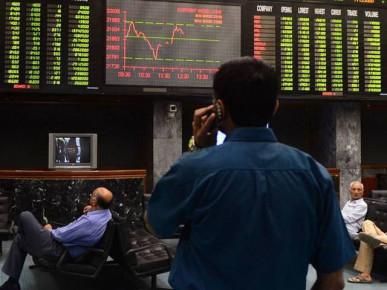
KARACHI: The Pakistan Stock Exchange (PSX) came under renewed selling pressure Monday, with the benchmark KSE-100 Index falling more than 400 points in early trading as escalating tensions between the United States and Iran unsettled investors.
At around 9:40 a.m., the KSE-100 Index stood at 177,242.03 points, down 454.47 points, or 0.26%, from the previous close.
Selling pressure was visible across several major sectors, including automobile assemblers, cement, commercial banks, oil and gas exploration companies, oil marketing companies and power generation firms.
Major stocks including HBL, MCB, MEBL, MARI, OGDC, PPL, PSO and HUBCO were trading in negative territory.
The pressure followed a largely range-bound session during the previous week. The KSE-100 had gained around 530 points, or 0.3%, to close at 177,696.52 points as uncertainty over the US-Iran standoff and prospects for reopening the Strait of Hormuz kept investors cautious.
The latest decline came amid a broader sell-off in Asian markets following renewed military confrontation between Washington and Tehran. Rising geopolitical risks pushed crude oil prices higher, while elevated bond yields added to concerns about global monetary policy.
Brent crude futures rose 1.4% to $89.38 per barrel after US forces reportedly struck two Iranian launchers on Larak Island on Sunday.
The geopolitical uncertainty has also influenced expectations for US interest rates. Market pricing indicated a higher probability of a September rate increase, with investors closely monitoring upcoming US employment and inflation data for clues about the Federal Reserve’s next policy decision.
Economists expect the August payroll report to show a recovery of about 58,000 jobs following an unexpected decline of 23,000 jobs in July. The unemployment rate is forecast to remain around 4.1%. A significantly weaker employment reading could ease expectations of an early rate hike.
Higher bond yields and heightened geopolitical tensions weighed on Asian equities. Japan’s Nikkei fell about 2.1%, while South Korean stocks declined 2.4%. MSCI’s broadest index of Asia-Pacific shares outside Japan also dropped around 0.7%.
About The Author