

Pakistan’s military says more than 54 militants were killed while 42 security personnel and civilians lost their lives during multiple counterterrorism operations launched after a series of coordinated attacks across Balochistan.
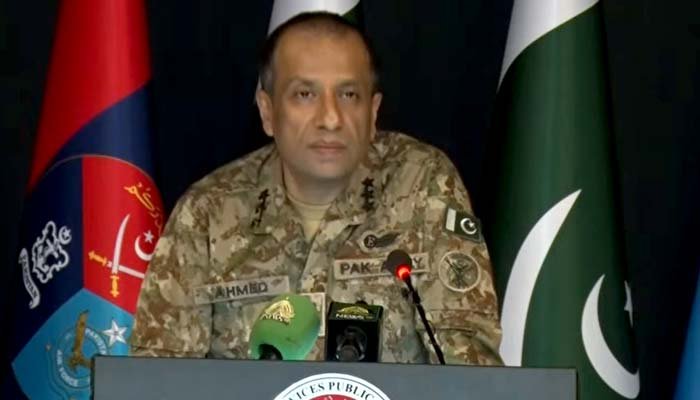
Pakistan’s security forces have killed more than 54 militants during a series of intelligence-based operations (IBOs) and counterterrorism engagements across Balochistan over the past four days, while 42 security personnel and civilians were martyred, according to Inter-Services Public Relations (ISPR) Director General Lt-Gen Ahmed Sharif Chaudhry.
Speaking at a press conference in Islamabad on Wednesday, the military spokesperson said the operations were launched after a wave of coordinated terrorist attacks targeted security forces and civilians in different parts of the province. He stated that three major incidents occurred during the past four days and described the attackers as militants belonging to “Fitna al-Khawarij,” accusing them of targeting innocent people to advance their objectives.
Providing details of the Ziarat Mangi attack, Lt-Gen Chaudhry said nine Balochistan Police personnel were martyred during the initial assault on a police check post near Mangi Dam. Eighteen additional police officials, who had been taken hostage by the attackers, were later killed by the militants, bringing the police death toll in the incident to 27.
According to the military, the violence began on the night of July 6 when heavily armed militants attacked the remote police check post. Despite being outnumbered, police personnel reportedly killed 15 militants during the initial exchange of fire before the attackers overpowered the remaining officers and took them hostage.
Security forces, including the Pakistan Army, Frontier Corps (FC), and other law enforcement agencies, launched a large-scale cordon and search operation on July 7 in the mountainous terrain of Ziarat. The military said commanders deliberately avoided using air power and heavy weapons in an effort to protect the hostages and minimize collateral damage.
On July 8, officials said the militants killed the 18 hostages before security forces carried out the final clearance operation, during which 11 additional militants were eliminated. The total number of militants killed in the Ziarat operation reached 26.
The violence also spread to other parts of the province. An army convoy travelling on the N-25 highway near Bela-Winder came under attack by militants identified by the military as members of the banned Baloch Liberation Army (BLA). During the ensuing exchange of fire, 11 army personnel—including one junior commissioned officer (JCO) and 10 soldiers—were martyred, while 14 militants were killed.
Separate intelligence-based operations were also conducted in Kharan and Dalbandin. The military said six militants linked to Fitna al-Khawarij were killed in Kharan, while eight militants described as foreign-backed were eliminated during an operation in Dalbandin.
Overall, the military reported that 42 Pakistanis were martyred during the recent violence, including 27 Balochistan Police personnel, 11 Pakistan Army personnel, and four civilians. It said 54 militants were killed across the operations, including 26 in Ziarat, 14 near the N-25 highway, six in Kharan, and eight in Dalbandin.
During the press conference, Lt-Gen Chaudhry reaffirmed Pakistan’s commitment to continuing counterterrorism operations, stating that there would be no compromise in the fight against militancy. He alleged that Afghan territory was being used for anti-Pakistan terrorist activities and further claimed that India was sponsoring terrorism in Balochistan. He reiterated the military’s longstanding position that “Fitna al-Khawarij” has no connection with Islam and said the state would continue pursuing militants, their facilitators, financiers, and supporters.
The ISPR chief emphasized that peace and development in Balochistan remain a national priority, adding that the armed forces, law enforcement agencies, and the people of Pakistan would continue working together to counter terrorism. He also reiterated the government’s policy regarding the identification and repatriation of illegal Afghan nationals, saying the state would not be deterred from pursuing its security objectives.
About The Author