

Pakistan and China are placing B2B partnerships, industrialisation, technology transfer and export growth at the centre of CPEC 2.0.
ISLAMABAD: Pakistan and China are moving toward a more business-focused model of cooperation under the second phase of the China-Pakistan Economic Corridor, with Business-to-Business partnerships expected to play a greater role in driving investment, industrial growth and exports.
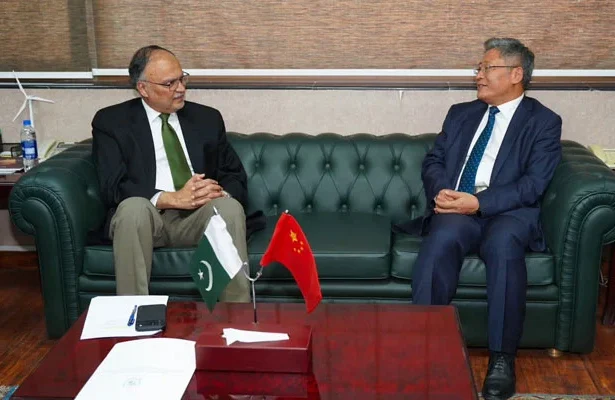
The shift emerged during a meeting between Planning Minister Ahsan Iqbal and a Chinese delegation led by Sun Dongsheng, Senior Advisor, Economic Affairs Press, at the CPEC Secretariat. Discussions focused on strengthening industrial and commercial cooperation between the two countries.
From infrastructure to industrialisation
Iqbal briefed the delegation on Pakistan’s Uraan Pakistan economic transformation programme and outlined priorities for CPEC 2.0. He called for closer cooperation with Chinese institutions in advanced manufacturing, automation, robotics and innovation.
The minister said Pakistan needed to expand its productive capacity and adopt modern technologies to compete in the era of Industrial Revolution 4.0 and prepare for emerging technologies associated with Industrial Revolution 5.0.
He also identified Pakistan’s limited export base as a major economic challenge, stressing the need to connect agriculture, manufacturing and other productive sectors more effectively with international markets.
Pakistan seeks greater access to China
Iqbal urged stronger facilitation for Pakistani exports to China. He highlighted the significant trade gap, noting that China imports goods worth around $2.6 trillion annually while Pakistan’s exports to the Chinese market remain close to $3 billion.
He said Pakistan must improve production standards, competitiveness and business capacity to increase its share of the Chinese market.
The government hopes CPEC 2.0 can help reduce the country’s export deficit by supporting industrial development, technology transfer and stronger commercial links.
Private sector takes centre stage
The first phase of CPEC focused heavily on infrastructure and energy, with nearly $30 billion invested in infrastructure and power-sector projects.
The second phase is expected to place greater emphasis on commercial partnerships between Pakistani and Chinese companies. Businesses are being encouraged to explore joint ventures and investment opportunities in manufacturing, agriculture and mining.
Chinese officials also highlighted the importance of involving small and medium-sized manufacturing enterprises in bilateral cooperation, alongside greater emphasis on skills, innovation and technology transfer.
CPEC 2.0 linked with Uraan Pakistan
Officials also discussed aligning CPEC 2.0’s Five Corridors with Pakistan’s 5Es framework under Uraan Pakistan, covering exports, e-Pakistan, environment and climate change, energy and infrastructure, and equity and empowerment.
The consultations indicate that the success of CPEC 2.0 will increasingly be judged by its ability to generate productive investment, expand exports, modernise industries, create employment and improve Pakistan’s competitiveness.
About The Author