
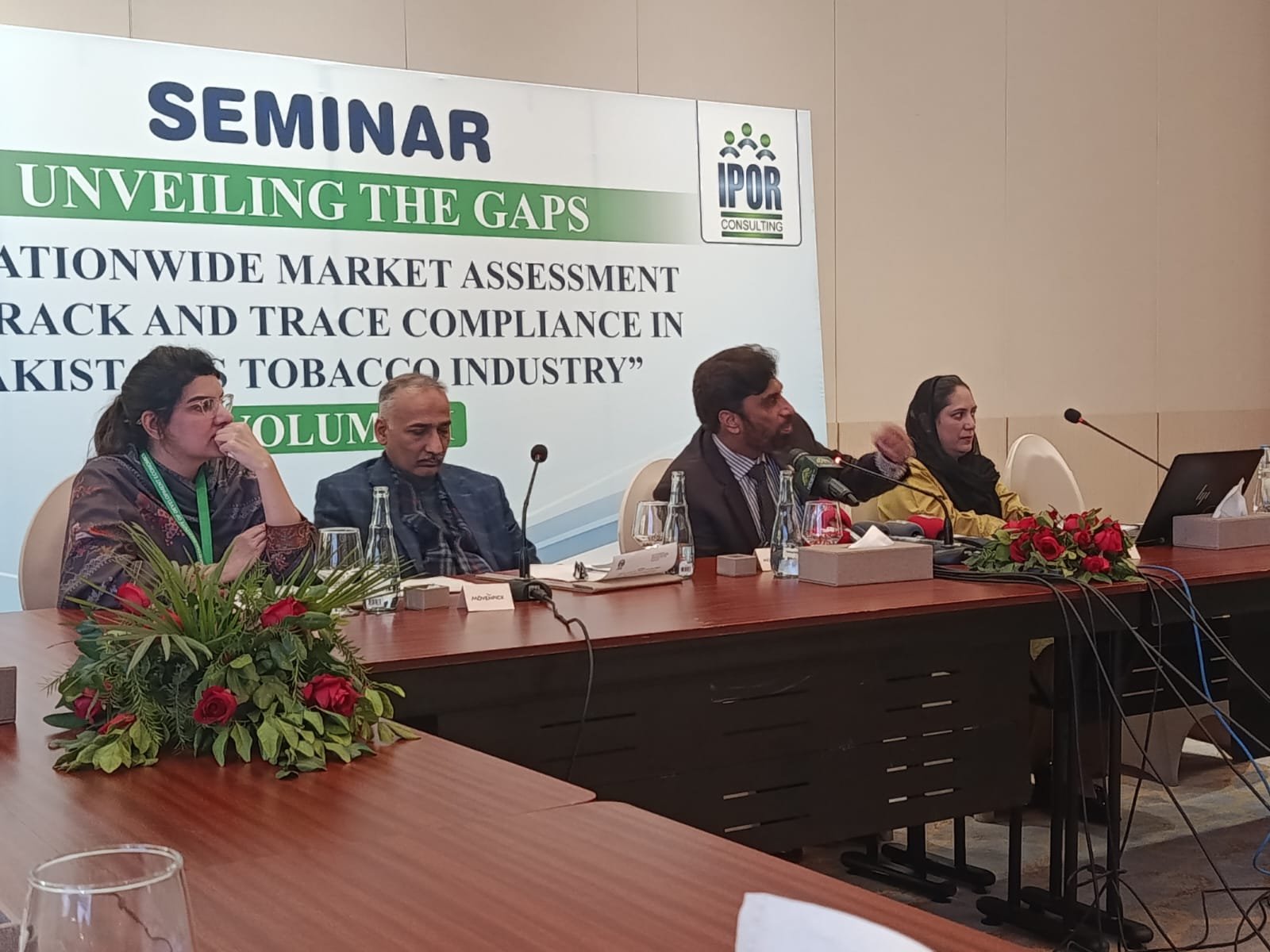

ISLAMABAD:(Ayesha Naz)- The Institute for Public Opinion Research (IPOR) has released its second research report on the implementation of the Track and Trace System (TTS) in Pakistan’s tobacco industry, highlighting serious gaps in the enforcement of the Federal Board of Revenue’s tracking mechanism.
The findings were presented during a policy dialogue held in Islamabad, where the Minister of State for Finance and Railways, Bilal Azhar Kiyani, attended as the chief guest.
Presenting the report, IPOR Executive Director Tariq Junaid said the research was based on data collected from 1,520 retail shops across 38 markets in 19 districts nationwide. According to the findings, 51 percent of cigarette brands available in the market fail to comply with government regulations. Violations include the absence of track and trace stamps, non-compliance with the minimum legal price, and the lack of mandatory pictorial and textual health warnings as required by the Ministry of Health.
The report revealed that out of 477 cigarette brands surveyed, only 49 percent were fully compliant with regulations. A total of 320 smuggled brands and 121 locally manufactured brands were found to be sold without track and trace stamps. The minimum legal price of Rs162.25 per pack was also widely violated, with only a limited number of brands being sold above the prescribed rate.
The research further noted that while retailers were generally aware of the track and trace system, only 40 percent reported facing any difficulty in selling illegal cigarettes, indicating weak enforcement at the retail level.
Speaking at the event, Pakistan Institute of Development Economics (PIDE) Registrar and economist Dr Nasir Iqbal said the situation reflects institutional weaknesses and poor coordination among relevant authorities. He stressed that the issue cannot be resolved without combining fiscal discipline with effective regulatory reforms.
PIDE Assistant Chief (Policy) Mehwish Mumtaz emphasised the importance of evidence-based policymaking, noting that weak enforcement is causing revenue losses and posing serious risks to public health.
FBR Project Director for the Track and Trace System, Javed Iqbal, stated that monitoring mechanisms are being strengthened and actions against illicit trade are being intensified.
In his address, Minister of State Bilal Azhar Kiyani reaffirmed the government’s commitment to the effective implementation of the track and trace system. He said that strict monitoring, strong legislation, and improved inter-agency coordination are essential to eliminate illegal trade.
The policy dialogue concluded with recommendations calling for stricter enforcement at the retail level, improved coordination among institutions, and more effective use of taxation and pricing mechanisms. IPOR reiterated its commitment to supporting policymakers through evidence-based research to strengthen Pakistan’s tax system, stabilise the economy, and protect public health.
About The Author