

New analysis highlights Pakistan’s growing reliance on alternative corridors to enhance regional trade and bypass traditional Afghan routes.
ISLAMABAD: Pakistan is increasingly focusing on alternative transit corridors through China and Iran to strengthen its connectivity with Central Asian Republics, signaling a strategic shift away from reliance on Afghanistan for regional trade routes.
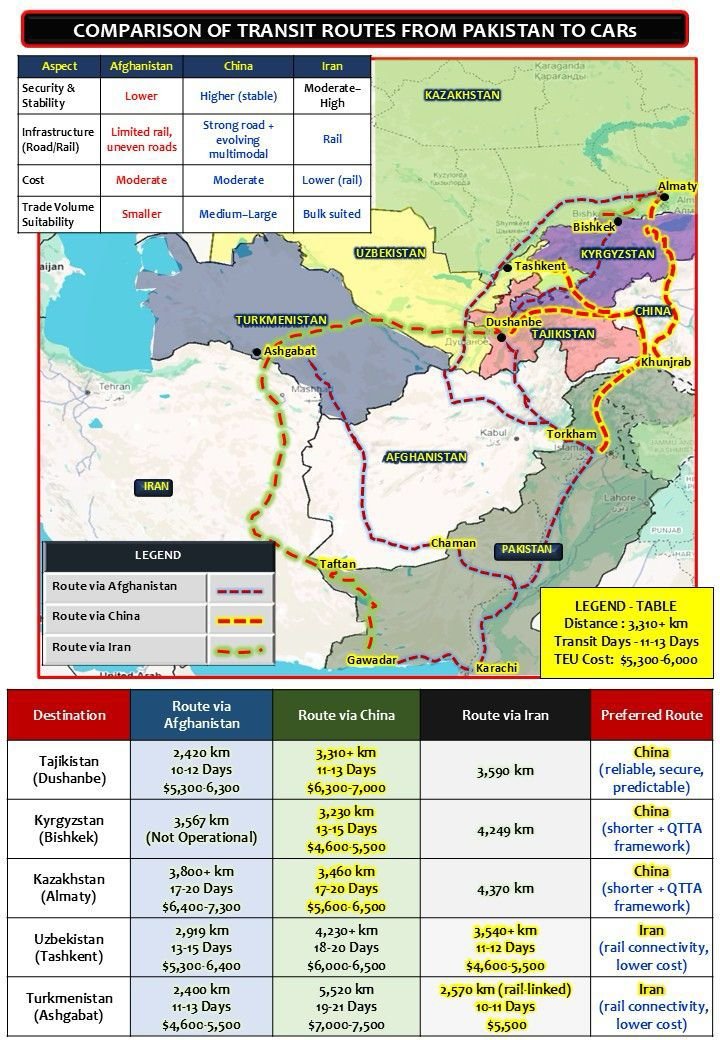
According to recent analysis, evolving ground realities have demonstrated that routes via China and Iran offer more reliable, secure, and operationally viable pathways for trade with countries such as Tajikistan, Kyrgyzstan, Kazakhstan, Uzbekistan, and Turkmenistan.
The China corridor, particularly through the western region and the Khunjerab Pass, is being described as the most reliable gateway. Data suggests that routes to key destinations such as Bishkek and Almaty are shorter and more predictable compared to Afghan routes, with improved infrastructure and reduced transit risks. Analysts point out that integration under the China-Pakistan Economic Corridor framework has significantly enhanced logistics capacity and connectivity.
Meanwhile, the Iran corridor has emerged as a cost-effective alternative, particularly for access to Uzbekistan and Turkmenistan. The activation of the Gabd-Rimdan crossing in April 2026 has further strengthened this route, enabling direct trade flows and reducing dependency on traditional transit pathways.
In contrast, routes as Afghanistan continue to face multiple challenges, including security concerns, inconsistent border operations at crossings such as Torkham and Chaman, higher transit costs, and limited infrastructure. Experts note that these constraints have reduced the practical utility of Afghan corridors despite their geographical proximity.
Pakistan is also investing in key infrastructure projects to support this transition. The planned upgrade of the Main Line-1 Railway and continued development under CPEC Phase II are expected to enhance connectivity between ports and inland trade routes. Additionally, the strategic importance of Gwadar Port as a deep-sea, warm-water port is being highlighted as a critical component in linking Pakistan to Central Asia without relying on Afghan transit.
Analysts believe that this evolving strategy positions Pakistan as a potential regional transit hub, enabling greater trade integration, energy cooperation, and economic influence across the region.
The shift reflects a broader geo-economic recalibration, with Islamabad seeking to capitalize on alternative corridors that offer greater stability, predictability, and long-term sustainability for regional trade.
About The Author