

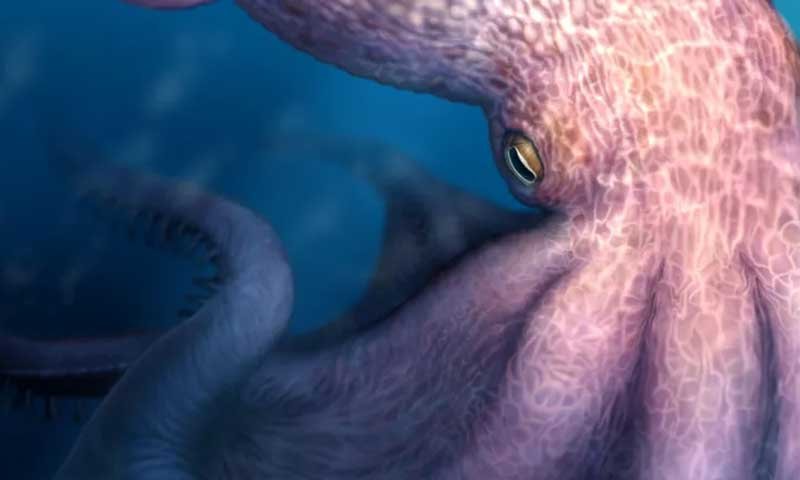

New fossil evidence suggests giant intelligent octopuses dominated Cretaceous oceans, challenging long-standing views of ancient marine ecosystems.
A groundbreaking scientific study has revealed that enormous octopus-like predators, some possibly stretching up to 19 metres in total length, may have ruled Earth’s oceans around 100 million years ago during the Cretaceous period. The discovery reshapes long-held assumptions about prehistoric marine life, suggesting that highly intelligent invertebrates once competed with some of the most powerful vertebrate predators of the dinosaur era.
The research, led by scientists at Hokkaido University and published in Science, is based on exceptionally preserved fossilized jaw structures. These remains indicate that ancient cephalopods possessed powerful beak-like jaws capable of crushing hard shells and possibly even bones, pointing to a far more aggressive and dominant ecological role than previously believed.
Fearsome predators of ancient seas
According to the study, these prehistoric octopuses likely had strong, muscular arms used for capturing prey, combined with highly developed jaws designed to break through the armored exoskeletons of marine creatures. Researchers estimate their core body size may have ranged between 1.5 and 4.5 metres, but when fully extended arms are considered, their total length could have reached between 7 and 19 metres.
Even the smallest estimates place them far beyond modern species in scale. Today’s largest known octopus, the Giant Pacific Octopus, reaches arm spans of over 5.5 metres and is already considered one of the ocean’s top invertebrate predators.
Scientists believe these ancient hunters likely targeted a wide range of marine life, including ammonites and possibly small marine reptiles. Their role as active predators challenges earlier theories that ancient octopuses were relatively minor participants in ocean ecosystems.
Fossil jaws reveal behavioral clues
One of the most intriguing findings involves uneven wear patterns on fossilized jaws, suggesting possible side preference while feeding. Researchers believe this may indicate lateralisation—a neurological trait linked to more advanced cognitive processing in modern animals.
Modern octopuses are already known for their intelligence, problem-solving skills, and advanced camouflage abilities. Some species are capable of complex hunting strategies and have even been observed interacting with sharks in aggressive encounters, reinforcing their reputation as highly capable predators.
Palaeontologist Christian Klug highlighted that the combination of strength, dexterity, and intelligence makes octopuses uniquely efficient hunters, even by modern marine standards.
A prehistoric mystery still unfolding
Despite the exciting findings, scientists caution that many aspects of these ancient giants remain unknown. Their exact body shape, swimming behavior, and possible fin structures have not been confirmed due to limited fossil evidence. Even their diet is still largely speculative, as no direct stomach content fossils have been discovered.
Researcher Nick Longrich suggests these creatures may have primarily hunted ammonites but likely acted as opportunistic predators, feeding on any prey they could overpower in their environment.
He emphasized that much about these ancient organisms remains uncertain, noting that fully understanding them will require further discoveries and analysis.
A new perspective on ancient oceans
The study offers a rare and fascinating glimpse into prehistoric marine ecosystems, where large, intelligent invertebrates may have played a far more dominant role than previously imagined. If confirmed, these findings could significantly alter scientific understanding of evolutionary competition in ancient oceans, revealing a world where octopus-like creatures stood among the top predators of their time.
About The Author