
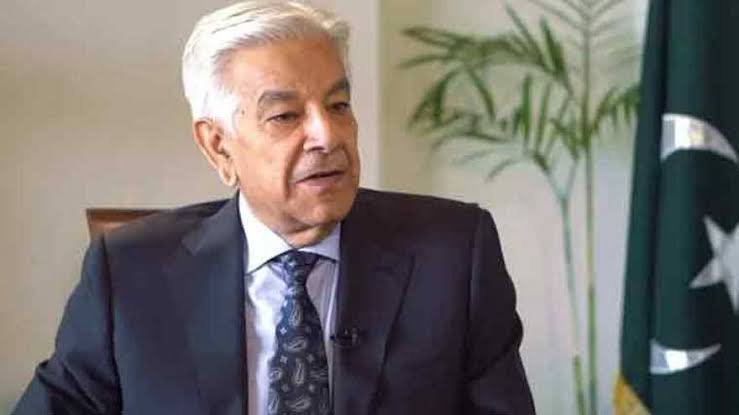

Defence Minister Khawaja Asif says Pakistan will fulfil its commitments under the Pakistan-Saudi-Turkiye defence agreement if Saudi Arabia’s territorial integrity is threatened.
Pakistan will provide practical and diplomatic support to Saudi Arabia if the conflict involving Yemen’s Houthi rebels escalates, Defence Minister Khawaja Asif has said, reaffirming Islamabad’s commitment to its defence agreement with Riyadh and Ankara.
Asif said Pakistan would fulfil its obligations under the trilateral defence agreement between Pakistan, Saudi Arabia and Turkiye, which provides for collective action if the territorial integrity of any member comes under threat.
“There is no ambiguity” about Pakistan’s commitment, Asif said in a television interview, adding that Islamabad would honour the agreement according to its terms.
The minister also stressed that Pakistan’s commitment to protecting Makkah and Madinah was not dependent solely on a formal defence agreement. He described the protection of the holy sites as a religious responsibility and said Muslims would not need to wait for an agreement if the sites came under attack.
Asif declined to disclose details of any military or defence strategy concerning the Houthis, saying such matters could not be discussed publicly.
He also said he considered it unlikely that Iran, as a state, would directly support the Houthis by opening another front in the region. According to Asif, Iran was already dealing with another conflict and expanding the confrontation into another theatre could create a wider regional crisis.
The comments came as tensions between Saudi Arabia and the Houthis remained elevated. Saudi authorities recently reported intercepting a Houthi drone near Makkah, while the Houthis rejected the accusation and denied targeting the holy city.
Inter-Services Public Relations Director General Lt. Gen. Ahmed Sharif Chaudhry also described the Pakistan-Saudi-Turkiye agreement as defensive, saying it was designed for collective deterrence and had no offensive or regional expansion agenda.
The military spokesperson said the agreement formalised Pakistan’s longstanding defence relationship with Saudi Arabia and its ties with Turkiye. He also rejected the description of the pact as an exclusive alliance for Muslim countries, saying it was aimed at regional stability.
The agreement was signed by Pakistan, Saudi Arabia and Turkiye on Aug. 7. It states that an attack on one member would be treated as an attack on all members.
The first meeting under the agreement was held in Istanbul on Aug. 31, with Pakistan selected to initially lead the alliance’s secretariat for three years.
Officials have said possible expansion to other countries could be considered later, but the three founding members would first need to establish the new mechanism.
The latest statements come amid intensified fighting between the Houthis and forces aligned with Yemen’s government. Houthi attacks have also affected Saudi territory and shipping routes, adding pressure around the strategically important Red Sea and Bab al-Mandab.
About The Author