


New guidance from Washington closes regulatory gaps as the US-China technology rivalry intensifies over advanced artificial intelligence and semiconductor development.
The United States has moved to tighten its control over advanced artificial intelligence (AI) chip exports, extending strict restrictions to overseas subsidiaries of Chinese companies in a bid to prevent potential loopholes in existing regulations.
The new guidance, issued by the US Department of Commerce through its Bureau of Industry and Security (BIS), clarifies that stringent licensing requirements for advanced AI semiconductor exports apply globally to companies headquartered in China or owned by Chinese parent firms. The announcement comes as Washington continues efforts to limit Beijing’s access to cutting-edge technology considered critical for AI development and high-performance computing.
According to the updated guidance, Chinese-owned entities operating outside mainland China will remain subject to US export controls, regardless of their location. The clarification follows growing uncertainty among businesses and industry stakeholders after recent policy changes under the administration of Donald Trump.
The move also follows the cancellation of the “Framework for Artificial Intelligence Diffusion,” a policy proposal introduced during the administration of Joe Biden. The framework sought to establish a global licensing system for advanced AI processors and impose export limits on many countries while granting broader access to close US allies.
Major technology companies had criticized the earlier framework, arguing that it could hinder innovation and disrupt international collaboration. Semiconductor giant Nvidia was among the most vocal opponents, warning that excessive restrictions could negatively affect the global technology ecosystem. The Trump administration ultimately withdrew the proposal, citing concerns about regulatory complexity and diplomatic consequences.
Following the rollback, questions emerged regarding the enforcement of existing export controls. Industry experts and former officials warned that regulatory ambiguity could allow advanced AI chips to reach Chinese firms through overseas subsidiaries. The latest BIS guidance appears aimed at addressing those concerns by explicitly confirming that such entities remain covered under US restrictions.
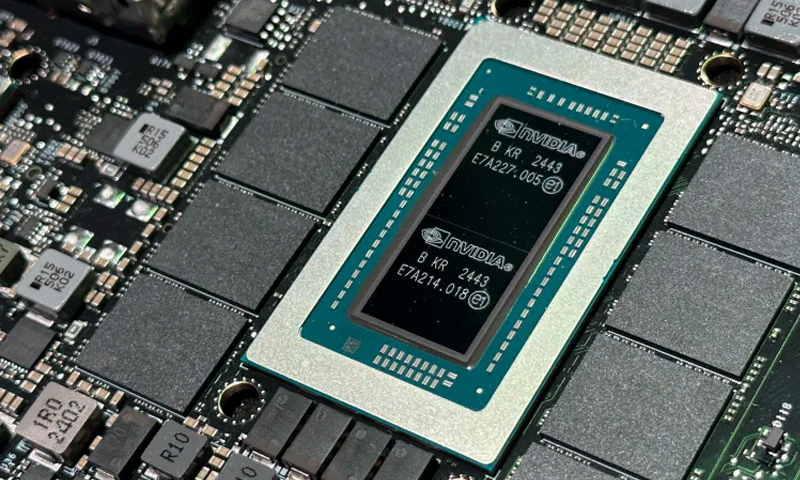
Nvidia stated that it is complying with the updated guidance. Its advanced Blackwell graphics processing units (GPUs) are already prohibited from direct export to China. Other leading semiconductor firms, including AMD, Intel and TSMC, did not immediately issue public responses following the announcement.
The latest policy highlights the continuing strategic competition between the United States and China over advanced semiconductor technologies. AI chips have become a central focus of national security and economic policy, with both countries investing heavily in securing leadership in artificial intelligence, cloud computing and next-generation digital infrastructure.
Despite tightening restrictions, Washington has occasionally allowed limited exports of less advanced semiconductor products to China under specific licensing arrangements, indicating that some channels for technology trade remain open under closely monitored conditions.
About The Author